By Eric Andrew Kristof, RN, CAHIMS | Healthcare IT Professional | HIMSS Arkansas Chapter Member
About This Series: The HIMSS Word of the Day is a running blog series drawing from the HIMSS Dictionary of Health Information and Technology Terms, Acronyms, and Organizations, 6th Edition (2025) — the authoritative reference for healthcare IT professionals and the primary study resource for CAHIMS and CPHIMS certification. Each post paraphrases the term in plain language, grounds it in real-world healthcare IT context, and adds a bedside nursing perspective you won’t find in a textbook.
📖 The Term: Minimum Necessary
Source: HIMSS Dictionary of Health Information and Technology Terms, Acronyms, and Organizations, 6th Edition (2025)
🔍 Plain-Language Definition
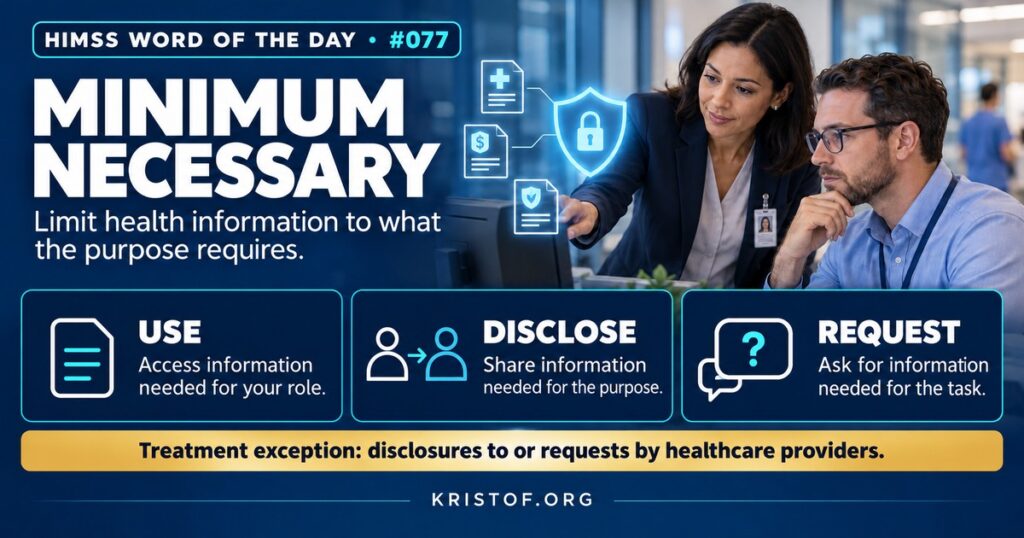
The minimum necessary standard is a HIPAA Privacy Rule principle requiring covered entities and business associates to make reasonable efforts to limit the protected health information they use, disclose, or request to the smallest amount needed to accomplish the intended purpose.
The HIMSS Dictionary describes minimum necessary as the least amount of protected health information required to carry out a permitted use or disclosure for payment or health care operations.
That focus on payment and operations reflects a key feature of the standard: it does not apply to disclosures to or requests by a health care provider for treatment. HHS guidance lists several situations where the standard does not apply.
| Minimum Necessary Applies | Minimum Necessary Does Not Apply |
|---|---|
| Internal uses by workforce members based on their roles | Disclosures to or requests by a health care provider for treatment |
| Routine disclosures for payment, such as claims to a health plan | Disclosures to the individual who is the subject of the information |
| Health care operations, such as quality review or auditing | Uses or disclosures made under the individual’s authorization |
| Requests the covered entity makes to other organizations | Disclosures to HHS for compliance or enforcement |
| Many disclosures to business associates | Disclosures required by law, and uses or disclosures required for HIPAA transaction standards |
⚠️ Exam Alert: Minimum necessary is about how much information is used or shared. It works alongside role-based access control, which limits who can see what. Remember the major treatment exception: clinicians sharing information to treat a patient are not limited by the standard, though professional judgment still applies. Questions often present a scenario, such as a billing clerk viewing full clinical notes, and ask which principle is involved.
🌐 Why It Matters: Real-World Healthcare IT Context
Electronic health records make enormous amounts of information available with a few clicks. The minimum necessary standard is one of the main ways HIPAA restrains that reach, asking organizations to design access and disclosure practices around what each role and request actually needs.
For internal uses, covered entities must identify which workforce members need access to protected health information, what categories they need, and any conditions on that access. In practice, that becomes role-based access in the EHR: registration staff see demographics and insurance, billing staff see what supports claims, and clinicians see what supports care.
For routine and recurring disclosures, organizations can set standard protocols, such as which documents go to a health plan for a typical claim. For non-routine disclosures, they must review each request against criteria designed to limit the information to what is reasonably necessary. Covered entities may reasonably rely on certain requests as minimum necessary, such as requests from other covered entities or from public officials who state that the information requested is the minimum necessary.
The standard also applies to requests. When a hospital asks another organization for information, it should request only what it needs.
Technology helps but does not replace judgment. EHR roles are often broad because clinicians need flexible access to care for patients, and the treatment exception supports that. Privacy monitoring, audit trails, and education fill the gap by detecting and discouraging access that is not related to a person’s job.
Common minimum necessary problems:
- Security roles that grant far more access than a job requires
- Entire records sent when a request needs only a few documents
- Printed reports with full patient details left in public areas
- Email or messages that include unnecessary identifiers
- Analytics extracts containing more fields than the project needs
- Curiosity-driven chart access by staff not involved in care
Practices that support minimum necessary:
- Role-based access designed with input from privacy, HIM, and department leaders
- Standard protocols for routine disclosures and reviews for non-routine ones
- De-identified or limited data sets for analytics where possible
- Report and print designs that show only what users need
- Privacy monitoring and audits of access patterns
- Ongoing education with practical, job-specific examples
🏥 The Nurse’s Perspective: Clinical, Bedside, & Workflow
Nurses rely on the treatment exception every day, yet minimum necessary thinking still shapes good privacy practice at the bedside.
At the Bedside
Handoffs, rounds, and family conversations involve sharing information, and much of it falls under treatment. Even so, nurses can be thoughtful about where and how they speak, lowering their voices in shared rooms, avoiding hallway conversations about sensitive details, and confirming whom the patient wants included before discussing information with visitors.
When a patient’s information is needed by a non-clinical department, such as transport or dietary, nurses can share what that team needs to do its job, such as isolation precautions or a diet order, without sharing unrelated diagnoses.
In Clinical Workflow
Printed and electronic reports deserve attention. A census or handoff sheet that lists diagnoses, room numbers, and code status is useful, but it should be kept secure, collected at the end of the shift, and disposed of properly. Choosing reports that show only what is needed reduces the risk if a sheet is misplaced.
Access to charts should follow the care relationship. Opening a chart to care for a patient is appropriate; opening it out of curiosity, for a coworker, or for a relative is not, even when the nurse has technical access.
In EHR Implementation (Go-Live Perspective)
During an Epic Go-Live, security roles are designed and tested for every job type. Teams balance minimum necessary principles against the reality that clinicians often need broad access for patient care. Requests for additional access are common in the first weeks and should go through a defined review process.
At-the-elbow support analysts should route access requests to the security team rather than suggesting workarounds, and should avoid showing more patient information than necessary when demonstrating features. Using training patients for tip sheets and screenshots is a simple way to apply minimum necessary during support.
🎓 CAHIMS / CPHIMS & HIMSS Perspective
CAHIMS Exam Domain Mapping
Minimum necessary is a core HIPAA privacy concept:
| CAHIMS Domain | How Minimum Necessary Appears |
|---|---|
| Healthcare & Technology Environments | HIPAA Privacy Rule requirements and exceptions; enforcement |
| Clinical Informatics | Treatment exception; privacy in handoffs, reports, and messaging |
| Healthcare Information & Systems Management | Role-based access, report design, data extracts, privacy monitoring |
| Management & Leadership | Policies for routine and non-routine disclosures, training, audits |
Key Terms to Know Alongside Minimum Necessary
- Role-Based Access Control (RBAC) — granting system access according to a user’s job role
- Least Privilege — giving users only the access necessary to perform their tasks
- Treatment Exception — the rule that minimum necessary does not apply to disclosures to or requests by providers for treatment
- Routine Disclosure — a recurring disclosure that can follow a standard protocol
- Limited Data Set — PHI with direct identifiers removed, used under a data use agreement
- Privacy Monitoring — review of access patterns to detect inappropriate use
HIMSS Organizational Position
HIMSS addresses minimum necessary and access control as part of privacy and cybersecurity, and engages on HIPAA privacy policy through its public policy work. Members can find related education and research through the HIMSS Resource Center.
🔗 Explore Further: External References
- HHS — Minimum Necessary Requirement https://www.hhs.gov/hipaa/for-professionals/privacy/guidance/minimum-necessary-requirement/index.html
- eCFR — 45 CFR 164.502, Uses and Disclosures of PHI: General Rules https://www.ecfr.gov/current/title-45/subtitle-A/subchapter-C/part-164/subpart-E/section-164.502
- eCFR — 45 CFR 164.514, Other Requirements Relating to Uses and Disclosures https://www.ecfr.gov/current/title-45/subtitle-A/subchapter-C/part-164/subpart-E/section-164.514
- HHS — Summary of the HIPAA Privacy Rule https://www.hhs.gov/hipaa/for-professionals/privacy/laws-regulations/index.html
- HHS — Uses and Disclosures for Treatment, Payment, and Health Care Operations https://www.hhs.gov/hipaa/for-professionals/privacy/guidance/disclosures-treatment-payment-health-care-operations/index.html
- HIMSS — Healthcare Cybersecurity Community https://www.himss.org/networking/communities/healthcare-cybersecurity/
Term source: HIMSS Dictionary of Health Information and Technology Terms, Acronyms, and Organizations, 6th Edition (2025). All definitions in this series are paraphrased for editorial purposes. Readers are encouraged to consult the primary source for exact language.
Eric Andrew Kristof, RN, CAHIMS is a Healthcare IT professional and HIMSS Arkansas Chapter member based in Hot Springs Village, AR, with hands-on Epic Go-Live experience and a diverse healthcare and IT background. He writes at kristof.org at the intersection of clinical care and healthcare technology.
Leave a Reply