By Eric Andrew Kristof, RN, CAHIMS | Healthcare IT Professional | HIMSS Arkansas Chapter Member
About This Series: The HIMSS Word of the Day is a running blog series drawing from the HIMSS Dictionary of Health Information and Technology Terms, Acronyms, and Organizations, 6th Edition (2025) — the authoritative reference for healthcare IT professionals and the primary study resource for CAHIMS and CPHIMS certification. Each post paraphrases the term in plain language, grounds it in real-world healthcare IT context, and adds a bedside nursing perspective you won’t find in a textbook.
📖 The Term: Use Case
Source: HIMSS Dictionary of Health Information and Technology Terms, Acronyms, and Organizations, 6th Edition (2025)
🔍 Plain-Language Definition
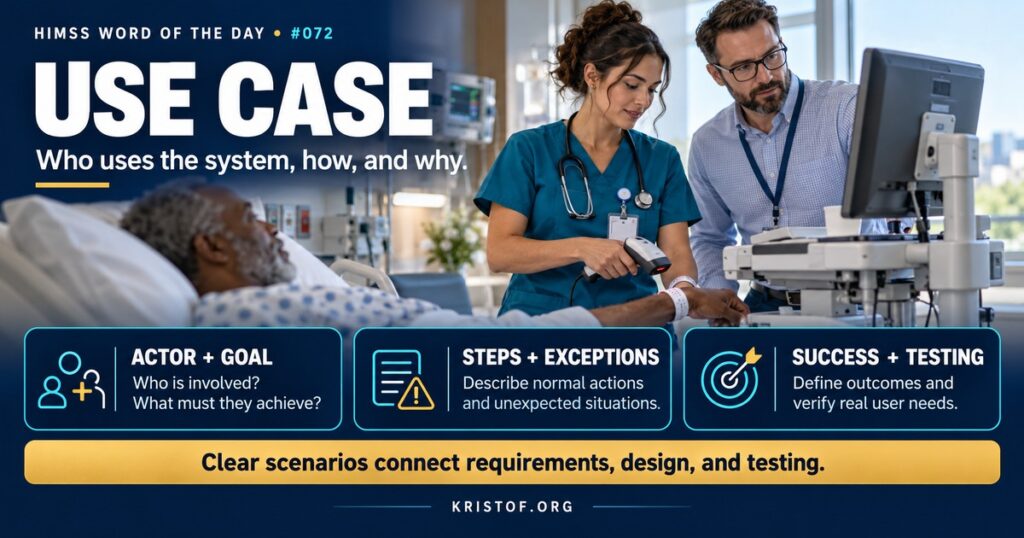
A use case describes how a person or another system uses a system to reach a specific goal. It spells out who is involved, what they are trying to do, the usual sequence of steps, and what happens when something unexpected occurs.
The HIMSS Dictionary describes a use case as a systems analysis method for identifying, clarifying, and organizing requirements. It explains that a use case consists of the possible sequences of interactions between users and systems in a given environment toward a particular goal, should include every system activity that matters to users, and can be viewed as a set of related scenarios that all aim at one goal. The Dictionary’s entry also addresses user acceptance testing (UAT), the phase in which real users or their representatives confirm in a controlled setting that a system satisfies the business needs it was built for and works well for the people using it, typically after functional testing is complete.
| Use Case Element | What It Describes | Example: Administer a Scheduled Medication |
|---|---|---|
| Actor | Who or what interacts with the system | Registered nurse; barcode scanner; pharmacy system |
| Goal | What the actor wants to accomplish | Give the correct dose to the correct patient and document it |
| Preconditions | What must be true before starting | Order is verified by pharmacy; patient has a wristband |
| Main Flow | The normal sequence of steps | Open eMAR, scan wristband, scan medication, confirm, document |
| Alternate Flows | Variations that still reach the goal | Patient refuses; dose held for low blood pressure |
| Exceptions | Errors or failures | Barcode will not scan; wrong medication scanned |
| Postconditions | What is true afterward | Administration documented; next dose scheduled |
⚠️ Exam Alert: A use case describes interactions toward a goal, including exceptions. A user story is a short agile statement of need, such as “As a nurse, I want to see overdue medications so that I can prioritize.” A workflow describes the whole process across people and tools. A test script turns a use case into steps and expected results for testing. Use cases are developed during requirements analysis and reused in testing.
🌐 Why It Matters: Real-World Healthcare IT Context
Many health IT problems trace back to unclear requirements. If designers do not understand how a system will actually be used, they build features that look complete but fail in real situations, especially the exceptions. Use cases force teams to think through those situations before build begins.
They also connect phases of the system life cycle. A use case written during analysis becomes the basis for design, then for integrated test scripts, and finally for user acceptance testing. When a test fails, the use case shows what the system was supposed to do.
Standards work relies on the same idea. IHE integration profiles begin by describing the clinical problem and use cases they address, then specify how existing standards should be combined to solve them. The Unified Modeling Language (UML), maintained by the Object Management Group, includes use case diagrams as a standard way to visualize actors and goals.
Use cases should include the hard parts. A medication administration use case that covers only the happy path will miss what happens when a barcode fails, a patient is off the unit, a dose is partially given, or the system is down. Those exceptions are where safety risks hide.
Use cases are also valuable when selecting systems. Instead of asking vendors whether a product supports a feature, organizations can provide scripted scenarios based on their own use cases, such as admitting a patient from the emergency department or reconciling medications at discharge, and watch each vendor demonstrate them. Scripted demonstrations reveal how many steps a task takes and how the system handles exceptions, which feature checklists rarely show.
Common use case weaknesses:
- Only the main flow is described, with no exceptions
- Actors are missing, such as unit clerks, students, or float staff
- Use cases written by analysts without clinical input
- Vague goals that cannot be tested
- No link between use cases and test scripts
- Use cases not updated when design decisions change
Characteristics of strong use cases:
- A clear, testable goal stated from the user’s point of view
- Complete actors, including other systems and devices
- Realistic alternate flows and exceptions
- Preconditions and postconditions that define success
- Traceability to requirements and test scripts
- Review and sign-off by clinical subject matter experts
🏥 The Nurse’s Perspective: Clinical, Bedside, & Workflow
Nurses carry detailed knowledge of the exceptions that make clinical use cases realistic.
At the Bedside
A nurse knows that medication administration rarely follows a single path. Patients are off the unit for tests, refuse doses, need medications crushed, or have IV access problems. Each of those situations is an alternate flow or exception that a good use case should cover. When nurses help write use cases, the resulting system is more likely to handle real bedside complexity.
Nurses also know the hidden actors: the charge nurse who reassigns patients, the unit clerk who manages transfers, the student nurse who documents under supervision, and the family member who needs information. Including those actors avoids gaps that appear only after Go-Live.
Use cases also make priorities visible. When analysts can see that a single use case, such as giving a time-critical antibiotic, touches ordering, pharmacy, the eMAR, and the pump, they can test the full chain rather than each piece in isolation.
In Clinical Workflow
Use cases support communication between clinical and technical teams. A clear use case written in plain language lets nurses confirm that analysts understood the workflow, and lets analysts ask precise questions. It replaces vague requests like “make documentation easier” with specific, testable goals.
Nurses who participate in user acceptance testing often work directly from scripts derived from use cases. Reporting where a script does not match real practice is valuable feedback, even if the system technically passes the test.
In EHR Implementation (Go-Live Perspective)
During an Epic implementation, workflow walkthroughs and integrated testing scripts play the role of use cases, describing how each role completes key tasks from start to finish. Nurses who review these scripts can catch missing steps, unrealistic assumptions, and exceptions that were not considered.
At-the-elbow support analysts see use cases come to life on Go-Live day. When a user hits a situation the scripts never covered, capturing it clearly helps the team add it to future testing and training, and sometimes reveals a build change that is needed.
🎓 CAHIMS / CPHIMS & HIMSS Perspective
CAHIMS Exam Domain Mapping
Use cases appear in systems analysis, design, and testing questions:
| CAHIMS Domain | How Use Cases Appear |
|---|---|
| Healthcare & Technology Environments | Standards profiles built on use cases; vendor selection requirements |
| Clinical Informatics | Capturing clinical requirements and exceptions; clinician involvement in design |
| Healthcare Information & Systems Management | Requirements analysis, UML diagrams, test scripts, user acceptance testing |
| Management & Leadership | Scope definition, traceability, sign-off, change control |
Key Terms to Know Alongside Use Case
- Actor — a person, role, or system that interacts with the system being described
- Main Flow — the normal sequence of steps that achieves the use case goal
- Alternate Flow — a variation in the steps that still achieves the goal
- User Story — a brief agile statement of a user’s need and its purpose
- User Acceptance Testing (UAT) — testing by real users to confirm the system meets their needs
- Traceability — the ability to link requirements to design, build, and test artifacts
HIMSS Organizational Position
HIMSS emphasizes clinician involvement in requirements and testing as part of safe, usable health IT, and the CPHIMS certification includes systems analysis and design. Members can find related education and research through the HIMSS Resource Center.
🔗 Explore Further: External References
- Object Management Group — Unified Modeling Language (UML) Specification https://www.omg.org/spec/UML/
- IHE International — Profiles https://www.ihe.net/resources/profiles/
- Manifesto for Agile Software Development https://agilemanifesto.org/
- ONC — SAFER Guides https://healthit.gov/clinical-quality-and-safety/safer-guides/
- Koppel et al. (2008), JAMIA — Workarounds to Barcode Medication Administration Systems https://pubmed.ncbi.nlm.nih.gov/18436903/
- HIMSS — Certifications (CAHIMS and CPHIMS) https://www.himss.org/certifications
Term source: HIMSS Dictionary of Health Information and Technology Terms, Acronyms, and Organizations, 6th Edition (2025). All definitions in this series are paraphrased for editorial purposes. Readers are encouraged to consult the primary source for exact language.
Eric Andrew Kristof, RN, CAHIMS is a Healthcare IT professional and HIMSS Arkansas Chapter member based in Hot Springs Village, AR, with hands-on Epic Go-Live experience and a diverse healthcare and IT background. He writes at kristof.org at the intersection of clinical care and healthcare technology.
Leave a Reply