By Eric Andrew Kristof, RN, CAHIMS | Healthcare IT Professional | HIMSS Arkansas Chapter Member
About This Series: The HIMSS Word of the Day is a running blog series drawing from the HIMSS Dictionary of Health Information and Technology Terms, Acronyms, and Organizations, 6th Edition (2025) — the authoritative reference for healthcare IT professionals and the primary study resource for CAHIMS and CPHIMS certification. Each post paraphrases the term in plain language, grounds it in real-world healthcare IT context, and adds a bedside nursing perspective you won’t find in a textbook.
📖 The Term: Natural Language Processing (NLP)
Source: HIMSS Dictionary of Health Information and Technology Terms, Acronyms, and Organizations, 6th Edition (2025)
🔍 Plain-Language Definition
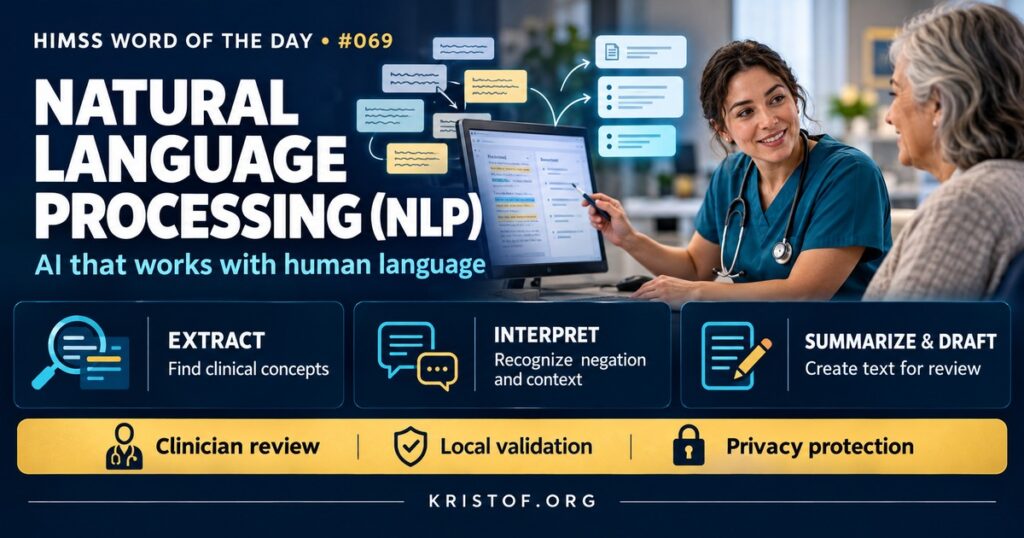
Natural language processing (NLP) is the part of artificial intelligence that enables computers to work with human language: reading text, finding meaning in it, summarizing it, translating it, and generating it.
The HIMSS Dictionary places NLP within artificial intelligence as the area focused on enabling computers to comprehend, interpret, and work with the language people use. It notes that NLP draws on several fields, including computer science and computational linguistics, as it works to bridge the gap between how people communicate and what computers can understand.
In healthcare, that gap is large. Clinical notes, discharge summaries, radiology and pathology reports, and patient messages contain information that is often missing from structured fields, written with abbreviations, negations, and shorthand that are hard for computers to interpret.
| NLP Task | What It Does | Healthcare Example |
|---|---|---|
| Named Entity Recognition | Finds concepts such as problems, drugs, and procedures in text | Identifying “atrial fibrillation” and “apixaban” in a note |
| Negation and Context Detection | Determines whether a concept is present, absent, historical, or about someone else | Recognizing “no chest pain” or “mother had breast cancer” |
| Normalization | Maps text to standard codes | Linking “heart attack” to a SNOMED CT concept |
| Classification | Assigns categories to documents or sentences | Flagging notes that mention fall risk or social needs |
| Summarization | Produces shorter versions of long text | Summarizing a lengthy hospital stay for a new clinician |
| Generation | Produces new text from inputs | Drafting a visit note from an ambient recording or a reply to a patient message |
⚠️ Exam Alert: NLP is a field of AI focused on language. Large language models (LLMs) are a type of model now widely used for NLP tasks. Machine learning is the broader method of learning patterns from data. Structured data is already coded; NLP is typically used to turn unstructured text into usable information. Expect questions that ask which technology fits a scenario, such as extracting diagnoses from free-text notes.
🌐 Why It Matters: Real-World Healthcare IT Context
NLP unlocks information that structured data misses. Health systems use it to identify patients for research cohorts, find follow-up recommendations buried in radiology reports, support coding and documentation review, detect adverse events, flag social needs mentioned in notes, and surface relevant history for clinicians.
The field has changed quickly. Earlier clinical NLP relied on rules, dictionaries, and statistical models trained for specific tasks, with open-source tools such as Apache cTAKES designed for clinical text. Large language models now handle many language tasks with less task-specific training, and ambient documentation tools listen to clinical conversations, with permission, and draft notes for clinicians to review.
These capabilities bring real benefits, especially for documentation burden, but also real risks. Generative models can produce fluent text that contains errors or invented details, often called hallucinations. Models may perform differently across dialects, languages, and patient groups. Notes drafted by AI become part of the legal record once signed, so clinician review is essential. Governance frameworks, such as NIST’s AI Risk Management Framework, encourage organizations to evaluate accuracy, bias, transparency, and privacy before and after deployment.
Evaluation needs to match the task. Extracting a list of diagnoses can be measured against chart review, but judging whether an AI-drafted note is complete and accurate requires clinicians to compare it with what actually happened in the encounter. Organizations that measure both accuracy and time saved, and that ask clinicians about their experience, get a more honest picture of value than those that track adoption alone.
Privacy matters too. Clinical text is full of identifiers, and sending it to external AI services requires appropriate agreements and security controls.
Common NLP pitfalls:
- Missed negations that turn “no pneumonia” into a pneumonia finding
- Abbreviations with multiple meanings, such as “MS”
- Models validated at one organization that perform worse at another
- Generated text accepted without careful review
- Patient information sent to tools without a business associate agreement
- Overreliance on summaries that omit important details
Characteristics of responsible NLP use:
- Clear use cases with measured accuracy on local data
- Human review for clinical decisions and signed documentation
- Monitoring for drift, errors, and differences across patient groups
- Transparency with clinicians and patients about where AI is used
- Contracts, security, and privacy controls appropriate to the data
- Feedback channels for users to report errors
🏥 The Nurse’s Perspective: Clinical, Bedside, & Workflow
Nurses write a large share of the narrative in the chart and increasingly see NLP-powered tools in their own workflows.
At the Bedside
Nursing notes, shift summaries, and patient education notes contain observations that structured fields may not capture, such as a patient’s mood, a family concern, or a subtle change in behavior. NLP tools can surface those observations for other clinicians or for quality teams, which makes clear, specific nursing narrative more valuable, not less.
Ambient and AI-assisted documentation tools are beginning to appear in nursing workflows, such as drafting shift summaries or handoff notes. Any AI-drafted text should be reviewed carefully, corrected where needed, and signed only when the nurse agrees it is accurate.
Patients may also encounter AI-generated text, such as summaries in the patient portal or translated instructions. Nurses who review those materials with patients can catch errors and confirm that the information makes sense before the patient relies on it.
In Clinical Workflow
Patient messages are another NLP use case. Some organizations use AI to sort incoming portal messages by urgency or to draft replies for clinicians to edit. Nurses who manage message pools play a key role in checking that urgent messages are not misclassified and that drafted replies are accurate and appropriate.
Abbreviations and copy-forward text affect NLP accuracy. Writing clearly, avoiding ambiguous abbreviations, and updating rather than copying old notes help both human readers and computer tools understand the record.
In EHR Implementation (Go-Live Perspective)
During an Epic implementation or optimization, NLP and AI features may be introduced in phases, often with pilot groups first. Teams decide which features are enabled, who reviews outputs, and how errors are reported.
At-the-elbow support analysts help clinicians understand where AI-generated content appears, how it is labeled, and how to edit or reject it. Clear guidance that clinicians remain responsible for what they sign helps build appropriate trust in these tools.
🎓 CAHIMS / CPHIMS & HIMSS Perspective
CAHIMS Exam Domain Mapping
NLP appears in AI, data, and documentation questions:
| CAHIMS Domain | How NLP Appears |
|---|---|
| Healthcare & Technology Environments | AI trends; large language models; regulation and governance of AI tools |
| Clinical Informatics | Ambient documentation; message triage; clinician review of AI output |
| Healthcare Information & Systems Management | Extracting structured data from text; terminology mapping; integration of AI services |
| Management & Leadership | AI governance, vendor evaluation, privacy agreements, measuring benefits and risks |
Key Terms to Know Alongside NLP
- Large Language Model (LLM) — a machine learning model trained on large amounts of text that can understand and generate language
- Ambient Documentation — technology that captures clinical conversations and drafts documentation for review
- Named Entity Recognition — identifying concepts such as diseases or drugs in text
- Hallucination — generated output that is fluent but incorrect or unsupported
- Unstructured Data — information such as free text that lacks a predefined format
- AI Governance — policies and processes for evaluating, deploying, and monitoring AI tools
HIMSS Organizational Position
HIMSS addresses NLP and generative AI through its work on artificial intelligence in healthcare, including education, research, and policy engagement on responsible AI use. Members can find related education and research through the HIMSS Resource Center.
🔗 Explore Further: External References
- NIST — AI Risk Management Framework https://www.nist.gov/itl/ai-risk-management-framework
- Apache cTAKES — Clinical Text Analysis and Knowledge Extraction System https://ctakes.apache.org/
- Rosenbloom et al. (2011), JAMIA — Data From Clinical Notes: The Tension Between Structure and Flexible Documentation https://pubmed.ncbi.nlm.nih.gov/21233086/
- FDA — Artificial Intelligence-Enabled Medical Devices https://www.fda.gov/medical-devices/digital-health-center-excellence/artificial-intelligence-enabled-medical-devices
- NLM — Unified Medical Language System (UMLS) https://www.nlm.nih.gov/research/umls/index.html
- HIMSS — Resource Center https://www.himss.org/resource-center
Term source: HIMSS Dictionary of Health Information and Technology Terms, Acronyms, and Organizations, 6th Edition (2025). All definitions in this series are paraphrased for editorial purposes. Readers are encouraged to consult the primary source for exact language.
Eric Andrew Kristof, RN, CAHIMS is a Healthcare IT professional and HIMSS Arkansas Chapter member based in Hot Springs Village, AR, with hands-on Epic Go-Live experience and a diverse healthcare and IT background. He writes at kristof.org at the intersection of clinical care and healthcare technology.
Leave a Reply