By Eric Andrew Kristof, RN, CAHIMS | Healthcare IT Professional | HIMSS Arkansas Chapter Member
About This Series: The HIMSS Word of the Day is a running blog series drawing from the HIMSS Dictionary of Health Information and Technology Terms, Acronyms, and Organizations, 6th Edition (2025) — the authoritative reference for healthcare IT professionals and the primary study resource for CAHIMS and CPHIMS certification. Each post paraphrases the term in plain language, grounds it in real-world healthcare IT context, and adds a bedside nursing perspective you won’t find in a textbook.
📖 The Term: De-Identified Health Information
Source: HIMSS Dictionary of Health Information and Technology Terms, Acronyms, and Organizations, 6th Edition (2025)
🔍 Plain-Language Definition
De-identified health information is health data that has had identifying details removed or transformed so that it cannot reasonably be used to identify the person it describes. Under HIPAA, information that meets the de-identification standard is no longer considered protected health information, which means the Privacy Rule’s restrictions no longer apply to it.
The HIMSS Dictionary describes de-identification as stripping individual identifiers so the information cannot be used to identify a person, and it notes that HIPAA’s protections no longer apply once information is de-identified. It points to the regulatory standard at 45 CFR 164.514(a) and (b): health information that meets that standard and its implementation specifications is treated as not individually identifiable.
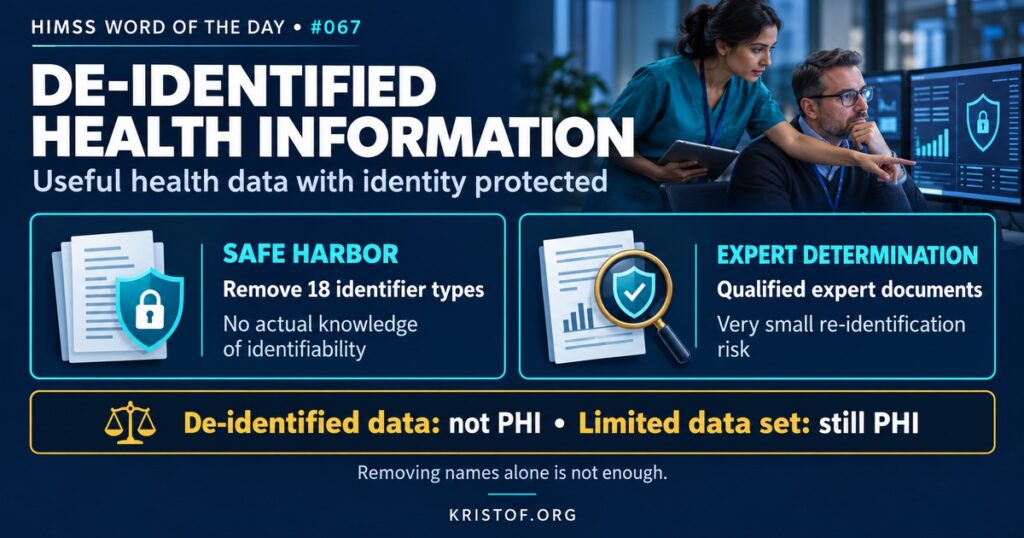
HIPAA offers two methods:
| Method | How It Works | Typical Use |
|---|---|---|
| Safe Harbor | Remove 18 specified types of identifiers about the individual and relatives, employers, or household members, and have no actual knowledge that the remaining information could identify the person | Straightforward data sets for internal analytics or sharing |
| Expert Determination | A qualified expert applies statistical or scientific methods and documents that the risk of re-identification is very small | Complex data sets where some detail, such as dates or geography, must be kept |
The Safe Harbor identifiers include names, geographic subdivisions smaller than a state (with a limited exception for parts of ZIP codes), all elements of dates except year for dates directly related to the individual, phone and fax numbers, email addresses, Social Security numbers, medical record numbers, health plan numbers, account numbers, license and vehicle numbers, device identifiers, web addresses, IP addresses, biometric identifiers, full-face photographs, and any other unique identifying number, characteristic, or code.
⚠️ Exam Alert: De-identified data is not PHI and is not covered by HIPAA. A limited data set still is PHI, keeps certain identifiers such as dates and city or ZIP code, and may be used only for research, public health, or health care operations under a data use agreement. Anonymized is a general term that may not meet HIPAA’s specific standard. Pseudonymized data replaces identifiers with codes and may still be identifiable.
🌐 Why It Matters: Real-World Healthcare IT Context
De-identification makes it possible to use health data for purposes beyond the care of an individual patient: research, quality improvement, public health, analytics, product development, and training artificial intelligence models. Without it, every secondary use would require individual authorization or another specific HIPAA permission.
HHS guidance explains both methods in detail, including how organizations may assign a code to allow authorized re-identification later, as long as the code is not derived from identifying information and the method for re-identifying is not disclosed.
De-identification is harder than it looks. Structured fields are relatively easy to remove, but identifiers hide in free-text notes, scanned documents, image headers, and even pixels. A radiology image may carry a name in its DICOM header or burned into the image itself. Rare conditions, unusual combinations of attributes, or small populations can make a record identifiable even after the Safe Harbor list is applied.
Re-identification risk also changes over time. As more data becomes publicly available, combining a de-identified data set with other sources can make linkage possible. For that reason, organizations increasingly pair de-identification with contractual controls, such as prohibitions on re-identification, and with secure environments that limit how data can be used.
Common de-identification pitfalls:
- Identifiers left in free-text notes or comments
- Full dates kept in data sets claimed to meet Safe Harbor
- Image headers or burned-in text not cleaned
- Small cell sizes in reports that reveal individuals
- Combining data sets in ways that recreate identities
- Assuming that removing names alone is sufficient
Characteristics of strong de-identification practice:
- Clear choice of method, documented for each data set
- Automated tools for structured data plus review of free text and images
- Expert Determination when detailed dates or geography are needed
- Contracts that prohibit re-identification attempts
- Governance review before data is released outside the organization
- Periodic reassessment as data sources and risks change
🏥 The Nurse’s Perspective: Clinical, Bedside, & Workflow
Nurses contribute to de-identified data sets more than they may realize, and they sometimes handle data that needs de-identification.
At the Bedside
Every structured entry a nurse makes, from vital signs to fall risk scores, may later appear in a de-identified data set used for research or quality analysis. That data helps answer questions about which interventions work and how care can improve. Accurate, structured documentation makes those analyses more reliable.
Narrative notes are a different matter. Details such as a patient’s job, hometown, or family situation are clinically useful but can identify someone if notes are shared for research. Organizations that use notes for analytics rely on careful de-identification tools and human review.
In Clinical Workflow
Nurses involved in quality improvement, evidence-based practice projects, or research may request data extracts. Choosing the least identifiable data that still answers the question, such as using age ranges instead of birth dates, protects patients and simplifies approvals. Many organizations route these requests through a governance or research office that decides whether de-identified data, a limited data set, or identifiable data with authorization is appropriate.
Presentations and posters deserve the same care. Removing names is not enough if a slide includes dates, room numbers, photos, or rare details that could identify a patient.
In EHR Implementation (Go-Live Perspective)
EHR implementations generate large amounts of data for testing and training. Many organizations build training environments with fictitious patients rather than copying real records, and when real data is used for testing, it is typically restricted or masked.
At-the-elbow support analysts should treat screenshots and examples with care. Using training patients for tip sheets and support tickets, rather than real patient screens, keeps identifiable information out of documents that may be widely shared.
🎓 CAHIMS / CPHIMS & HIMSS Perspective
CAHIMS Exam Domain Mapping
De-identification is a frequently tested privacy topic:
| CAHIMS Domain | How De-Identification Appears |
|---|---|
| Healthcare & Technology Environments | HIPAA Privacy Rule; research and public health uses; secondary use policy |
| Clinical Informatics | Quality improvement and evidence-based practice data requests |
| Healthcare Information & Systems Management | De-identification tools, image cleaning, data masking, secure analytics environments |
| Management & Leadership | Data governance, data use agreements, release review, re-identification risk |
Key Terms to Know Alongside De-Identified Health Information
- Safe Harbor Method — HIPAA de-identification by removing 18 specified identifiers with no actual knowledge of identifiability
- Expert Determination Method — HIPAA de-identification based on an expert’s documented finding of very small re-identification risk
- Limited Data Set — PHI with direct identifiers removed but certain dates and locations retained, shared under a data use agreement
- Data Use Agreement (DUA) — a contract governing how a limited data set may be used and protected
- Re-identification — linking de-identified data back to the individuals it describes
- Secondary Use — using data for purposes other than the reason it was originally collected
HIMSS Organizational Position
HIMSS addresses de-identification as part of privacy, data governance, and responsible use of data for analytics and AI, and engages on related policy through its public policy work. Members can find related education and research through the HIMSS Resource Center.
🔗 Explore Further: External References
- HHS — Guidance Regarding Methods for De-identification of Protected Health Information https://www.hhs.gov/hipaa/for-professionals/special-topics/de-identification/index.html
- eCFR — 45 CFR 164.514, Other Requirements Relating to Uses and Disclosures of PHI https://www.ecfr.gov/current/title-45/subtitle-A/subchapter-C/part-164/subpart-E/section-164.514
- HHS — HIPAA and Research https://www.hhs.gov/hipaa/for-professionals/special-topics/research/index.html
- HHS — Summary of the HIPAA Privacy Rule https://www.hhs.gov/hipaa/for-professionals/privacy/laws-regulations/index.html
- Safran et al. (2007), JAMIA — Toward a National Framework for the Secondary Use of Health Data https://pubmed.ncbi.nlm.nih.gov/17077452/
- OHDSI — Observational Health Data Sciences and Informatics https://www.ohdsi.org/
Term source: HIMSS Dictionary of Health Information and Technology Terms, Acronyms, and Organizations, 6th Edition (2025). All definitions in this series are paraphrased for editorial purposes. Readers are encouraged to consult the primary source for exact language.
Eric Andrew Kristof, RN, CAHIMS is a Healthcare IT professional and HIMSS Arkansas Chapter member based in Hot Springs Village, AR, with hands-on Epic Go-Live experience and a diverse healthcare and IT background. He writes at kristof.org at the intersection of clinical care and healthcare technology.
Leave a Reply