By Eric Andrew Kristof, RN, CAHIMS | Healthcare IT Professional | HIMSS Arkansas Chapter Member
About This Series: The HIMSS Word of the Day is a running blog series drawing from the HIMSS Dictionary of Health Information and Technology Terms, Acronyms, and Organizations, 6th Edition (2025) — the authoritative reference for healthcare IT professionals and the primary study resource for CAHIMS and CPHIMS certification. Each post paraphrases the term in plain language, grounds it in real-world healthcare IT context, and adds a bedside nursing perspective you won’t find in a textbook.
📖 The Term: Structured Data
Source: HIMSS Dictionary of Health Information and Technology Terms, Acronyms, and Organizations, 6th Edition (2025)
🔍 Plain-Language Definition
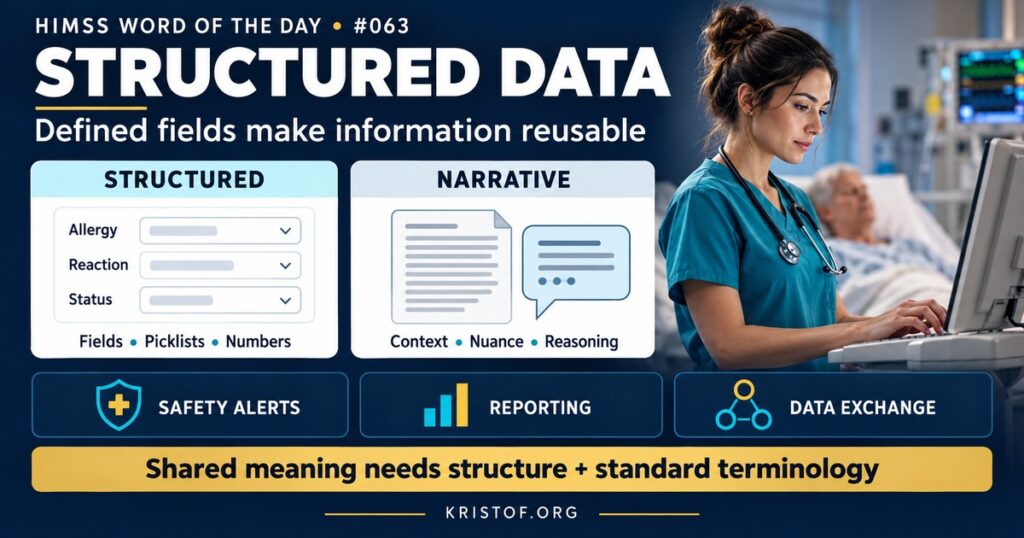
Structured data is information recorded in predefined fields, usually with standard codes, so that a computer can recognize exactly what it means. A blood pressure stored as two numbers with units, an allergy chosen from a coded list, or a diagnosis recorded with a standard code are all structured. A paragraph describing the same facts in a note is unstructured.
The HIMSS Dictionary describes structured data as coded data, built on a reference information model, that can be exchanged with its meaning intact, which is the idea behind semantic interoperability. Its example comes from consent management: a consent directive stored only as a scanned image cannot be read by a computer, so a consent repository could not automatically check it for conflicts with earlier directives.
That example captures the core point. Data that only a human can read is still useful, but data a computer can read can be checked, shared, counted, and used to drive alerts.
| Characteristic | Structured Data | Unstructured Data |
|---|---|---|
| Format | Defined fields, picklists, numbers, codes | Narrative text, images, scanned documents, audio |
| Example | Allergy: penicillin, reaction: hives, coded in the allergy list | “Patient says penicillin gave her a rash as a child” in a note |
| Computer Use | Alerts, reports, quality measures, exchange | Requires human reading or natural language processing |
| Strength | Consistent, searchable, comparable | Rich context, nuance, clinical reasoning |
| Weakness | Can feel rigid and add clicks | Hard to analyze or reuse at scale |
⚠️ Exam Alert: Structured data sits in defined fields; coded data uses a standard terminology such as SNOMED CT, LOINC, or RxNorm inside those fields. Data can be structured but uncoded, such as a local picklist with no standard mapping. Semantic interoperability requires both structure and shared meaning. Unstructured data, such as free text and scanned images, is not useless; it simply needs a person or natural language processing to interpret it.
🌐 Why It Matters: Real-World Healthcare IT Context
Most of what health IT promises depends on structured data. Clinical decision support needs a coded allergy to fire a drug-allergy alert. Quality measures need structured fields to calculate whether care was delivered. Health information exchange needs standard codes so that a receiving system can file a result correctly. Registries, population health tools, and predictive models all depend on data that can be counted and compared.
National policy reinforces this. USCDI defines a standard set of data classes and elements for exchange, with associated vocabulary standards, and certified EHRs must support them.
Structure has costs, though. A 2011 paper in JAMIA by S. Trent Rosenbloom and colleagues described the tension between structured documentation and flexible narrative. Clinicians value narrative expressivity and documentation that fits their workflow, and heavy reliance on structured entry can make notes less useful for communication. The authors recommended letting clinicians choose how to document based on workflow and need, while using other methods, including natural language processing, to extract reusable data from narrative.
Natural language processing is narrowing the gap. Tools that read notes can identify problems, medications, and social needs mentioned only in text, and ambient documentation tools increasingly draft notes from conversations. These tools help, but they still depend on structured, coded targets to place what they find, and their output needs clinician review.
The goal is the right structure in the right places: capturing data that drives safety, exchange, and measurement in structured form, while preserving narrative where clinical reasoning and nuance matter most.
Common structured data problems:
- Important facts recorded only in free text, invisible to alerts and reports
- Local picklists with no mapping to standard codes
- Required fields completed with default or “other” values just to move on
- Duplicate places to document the same item, leading to inconsistency
- Templates that generate long, hard-to-read notes from structured clicks
- Scanned outside records that never become usable data
Practices that improve structured data capture:
- Structure focused on high-value data such as allergies, medications, problems, vitals, and results
- Standard terminology mappings behind every clinical picklist
- Smart defaults and pull-forward that reduce re-entry
- One clear place to document each data element
- Narrative fields preserved for assessment and reasoning
- Regular review of how documented data is actually used
🏥 The Nurse’s Perspective: Clinical, Bedside, & Workflow
Nurses record much of the structured data in the EHR, especially in flowsheets, assessments, and admission documentation.
At the Bedside
Vital signs, intake and output, pain scores, fall risk, skin assessments, and allergies are typically documented as structured data. Each of those entries can feed an early warning score, a fall prevention alert, or a quality report. Recording them in the correct structured fields, rather than in a free-text comment, is what allows the system to act on them.
Narrative still matters. A brief note describing what changed, what the nurse observed, and what was communicated to the provider adds context that no checkbox can capture. Good nursing documentation uses both.
Allergies are a clear example. An allergy written only in a progress note may be read by the next nurse, but it will not trigger a drug-allergy alert in pharmacy or appear in the patient’s summary at another hospital. Moving it into the coded allergy list protects the patient everywhere the record travels.
In Clinical Workflow
Structured data supports nursing handoff and care planning. Patient summaries, shift reports, and worklists pull directly from flowsheet entries, so accurate structured documentation reduces the time spent re-explaining the same information at every handoff.
Flowsheet design shapes the experience. When rows are relevant, choices are clear, and a “not applicable” option exists where it should, nurses can document quickly and accurately. When rows are cluttered or required without reason, structured documentation becomes a burden that encourages shortcuts.
In EHR Implementation (Go-Live Perspective)
During an Epic Go-Live, nurses learn where structured data lives in the new system, from admission navigators to flowsheet groups and problem-based care plans. Some items that were free text in the legacy system become structured fields, and vice versa.
At-the-elbow support analysts often redirect documentation into the right structured location, such as moving an allergy from a note into the allergy activity or recording a weight in the correct flowsheet row with units. Those small corrections during the first weeks have a large effect on data quality for years afterward.
🎓 CAHIMS / CPHIMS & HIMSS Perspective
CAHIMS Exam Domain Mapping
Structured data appears in documentation, interoperability, and analytics questions:
| CAHIMS Domain | How Structured Data Appears |
|---|---|
| Healthcare & Technology Environments | USCDI and certification requirements; quality reporting programs |
| Clinical Informatics | Documentation design; balance of structure and narrative; decision support triggers |
| Healthcare Information & Systems Management | Data models, terminology mapping, interfaces, natural language processing |
| Management & Leadership | Data governance, documentation standards, measuring documentation burden |
Key Terms to Know Alongside Structured Data
- Unstructured Data — information without a predefined format, such as narrative notes, images, and scanned documents
- Discrete Data — individual data elements stored in their own fields
- Coded Data — data represented using codes from a standard terminology
- Semantic Interoperability — the ability of systems to exchange data with its meaning preserved
- Reference Information Model — an abstract model that defines how health data elements relate to one another
- Natural Language Processing (NLP) — computational methods for extracting meaning from text
HIMSS Organizational Position
HIMSS emphasizes structured, standards-based data as a foundation for interoperability, analytics, and decision support, while also working to reduce documentation burden through better design. Members can find related education and research through the HIMSS Resource Center.
🔗 Explore Further: External References
- Rosenbloom et al. (2011), JAMIA — Data From Clinical Notes: The Tension Between Structure and Flexible Documentation https://pubmed.ncbi.nlm.nih.gov/21233086/
- ONC — United States Core Data for Interoperability (USCDI) https://isp.healthit.gov/united-states-core-data-interoperability-uscdi
- NLM — SNOMED CT (United States) https://www.nlm.nih.gov/healthit/snomedct/index.html
- NLM — RxNorm https://www.nlm.nih.gov/research/umls/rxnorm/index.html
- HL7 — FHIR Terminologies https://hl7.org/fhir/terminologies.html
- ONC — Interoperability Standards Platform https://isp.healthit.gov/
Term source: HIMSS Dictionary of Health Information and Technology Terms, Acronyms, and Organizations, 6th Edition (2025). All definitions in this series are paraphrased for editorial purposes. Readers are encouraged to consult the primary source for exact language.
Eric Andrew Kristof, RN, CAHIMS is a Healthcare IT professional and HIMSS Arkansas Chapter member based in Hot Springs Village, AR, with hands-on Epic Go-Live experience and a diverse healthcare and IT background. He writes at kristof.org at the intersection of clinical care and healthcare technology.
Leave a Reply