By Eric Andrew Kristof, RN, CAHIMS | Healthcare IT Professional | HIMSS Arkansas Chapter Member
About This Series: The HIMSS Word of the Day is a running blog series drawing from the HIMSS Dictionary of Health Information and Technology Terms, Acronyms, and Organizations, 6th Edition (2025) — the authoritative reference for healthcare IT professionals and the primary study resource for CAHIMS and CPHIMS certification. Each post paraphrases the term in plain language, grounds it in real-world healthcare IT context, and adds a bedside nursing perspective you won’t find in a textbook.
📖 The Term: Project Management
Source: HIMSS Dictionary of Health Information and Technology Terms, Acronyms, and Organizations, 6th Edition (2025)
🔍 Plain-Language Definition
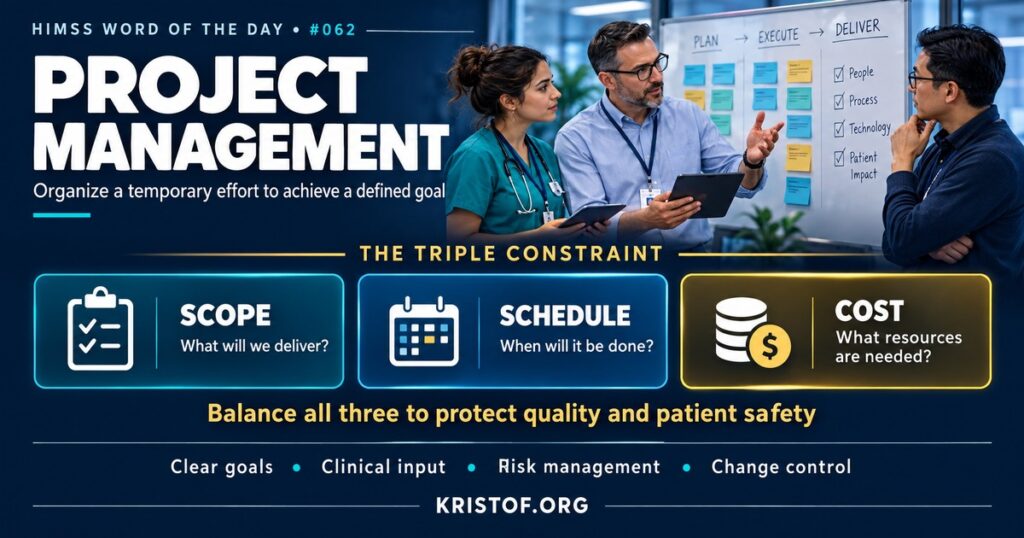
Project management is the discipline of organizing work so that a temporary effort, a project, achieves a defined goal. It answers practical questions: What exactly are we delivering? Who is doing each part? When will it be done? What will it cost? What could go wrong, and how will we know?
The HIMSS Dictionary describes project management as principles, methods, tools, and techniques for planning work effectively, which in turn provides a solid foundation for scheduling, controlling, and advance planning as programs and products are implemented and managed.
A project is temporary and unique: it has a start, an end, and a specific result. Ongoing operations, such as running the EHR day to day, are not projects, although upgrades and enhancements to them often are.
| Project Phase | Purpose | Health IT Example |
|---|---|---|
| Initiating | Define the goal, sponsor, and business case | Approving a project to add barcode scanning in the emergency department |
| Planning | Set scope, schedule, budget, resources, risks, and communication | Building a work breakdown structure and timeline |
| Executing | Do the work and coordinate the team | Configuring the system, building interfaces, training staff |
| Monitoring and Controlling | Track progress, manage changes, and correct course | Weekly status reports, issue logs, change control |
| Closing | Confirm results, transition to operations, capture lessons | Handing support to the operations team and holding a lessons-learned session |
⚠️ Exam Alert: The project life cycle describes how a project is managed, while the systems development life cycle describes the life of a system. The triple constraint links scope, schedule, and cost, with quality affected by all three. A work breakdown structure divides the scope into manageable pieces, and a Gantt chart shows tasks over time. Scope creep is uncontrolled growth in scope without matching changes to time or budget.
🌐 Why It Matters: Real-World Healthcare IT Context
Healthcare organizations run many technology projects at once: EHR upgrades, regulatory changes, new devices, interfaces, mergers, and optimization requests. Each competes for the same analysts, clinicians, and budget. Project management brings order to that work and makes trade-offs visible.
The triple constraint is the central trade-off. If a hospital adds features to a project, it must accept more time, more cost, or less of something else. If leaders fix a Go-Live date that cannot move, scope or resources must be adjusted to protect quality and safety. Making those choices deliberately is much safer than letting them happen by default.
Health IT projects add a dimension many industries do not have: patient safety. A delayed project costs money, but a rushed project can introduce errors into clinical workflows. That is why testing time, clinical validation, and readiness criteria deserve protection when schedules get tight.
Risk management deserves special attention. Good project teams keep a living risk register that names each risk, its likelihood and impact, an owner, and a response plan. In health IT, typical risks include key analysts leaving mid-project, vendor delays, interface partners that are not ready, competing regulatory deadlines, and clinical staffing shortages that limit time for testing and training. Reviewing the register regularly, rather than only at the start, turns risk management from paperwork into an early warning system.
Methods vary. Waterfall approaches suit large implementations with fixed sequences and deadlines. Agile approaches, which deliver small increments in short cycles with frequent feedback, suit optimization and custom development. Many organizations use a project management office (PMO) to standardize methods, prioritize work, and report on the portfolio.
Common reasons health IT projects struggle:
- Unclear goals or success measures from the start
- Missing or inactive executive and clinical sponsorship
- Scope creep without matching changes to time or budget
- Too few clinical subject matter experts available to the team
- Poor communication with the people whose work will change
- Risks identified but not actively managed
Practices that improve project outcomes:
- A clear charter with goals, scope, and measurable success criteria
- Engaged sponsors who remove barriers and make decisions
- Realistic schedules that protect testing and training
- Formal change control for scope changes
- Regular, honest status reporting with risks and issues visible
- Lessons-learned reviews that improve the next project
🏥 The Nurse’s Perspective: Clinical, Bedside, & Workflow
Nurses take part in health IT projects as subject matter experts, testers, trainers, and the people whose daily work changes most.
At the Bedside
Every project eventually lands at the bedside. A new medication workflow, a device, or a documentation change will alter how nurses spend their time. When project teams consult bedside nurses early, they learn about constraints that never appear in a requirements document, such as the number of workstations on a unit, how often patients move, or which shifts have the fewest resources.
Nurses also notice when a project’s timing collides with clinical reality. A Go-Live scheduled during a known high-census season or a staffing shortage may need adjustment, and raising that concern early is part of responsible project participation.
Feedback during testing is a form of project participation. When a nurse reports that a test scenario does not reflect how a task is really done, the project gains information that is far cheaper to act on before Go-Live than after.
In Clinical Workflow
Nurses often serve on project teams as clinical analysts, informatics nurses, or unit representatives. Their work includes reviewing designs, validating workflows, writing test scripts, and preparing training. Nurse informaticists frequently translate between clinical teams and technical teams, keeping projects grounded in safe practice.
Communication is a nursing strength that projects need. Explaining what is changing, why it matters, and what support will be available helps colleagues accept change and reduces resistance.
In EHR Implementation (Go-Live Perspective)
An Epic implementation is a large program made up of many coordinated projects: application build, interfaces, devices, reporting, training, technical infrastructure, and Go-Live support. Project managers track hundreds of milestones and dependencies, and readiness assessments determine whether the organization is truly prepared to go live.
At-the-elbow support analysts contribute to the final phases of the project. Issues they capture during Go-Live feed the issue log, and their observations about what worked and what did not inform lessons learned for future sites and phases.
🎓 CAHIMS / CPHIMS & HIMSS Perspective
CAHIMS Exam Domain Mapping
Project management is a core competency tested heavily on CPHIMS and present throughout CAHIMS:
| CAHIMS Domain | How Project Management Appears |
|---|---|
| Healthcare & Technology Environments | Regulatory deadlines and vendor timelines that drive projects |
| Clinical Informatics | Clinical engagement, workflow validation, safety considerations in scheduling |
| Healthcare Information & Systems Management | Project phases, testing plans, implementation strategies, transition to operations |
| Management & Leadership | Charters, triple constraint, risk management, stakeholder management, PMO governance |
Key Terms to Know Alongside Project Management
- Project Charter — a document that authorizes a project and defines its goals, scope, and sponsor
- Triple Constraint — the interdependence of scope, schedule, and cost, which together affect quality
- Work Breakdown Structure (WBS) — a hierarchical breakdown of project scope into deliverables and tasks
- Gantt Chart — a bar chart showing project tasks and their timing
- Critical Path — the longest sequence of dependent tasks that determines the earliest finish date
- Scope Creep — uncontrolled expansion of project scope without corresponding adjustments
HIMSS Organizational Position
HIMSS treats project management as an essential health IT leadership skill. The CPHIMS certification includes project management as a major content area, and HIMSS education and events regularly address managing implementations and portfolios. Members can find related resources through the HIMSS Resource Center.
🔗 Explore Further: External References
- HIMSS — Certifications (CAHIMS and CPHIMS) https://www.himss.org/certifications
- Manifesto for Agile Software Development https://agilemanifesto.org/
- NIST — SP 800-37 Rev. 2, Risk Management Framework https://csrc.nist.gov/pubs/sp/800/37/r2/final
- ONC — SAFER Guides https://healthit.gov/clinical-quality-and-safety/safer-guides/
- Ash, Berg, and Coiera (2004), JAMIA — Some Unintended Consequences of Information Technology in Health Care https://pubmed.ncbi.nlm.nih.gov/14633936/
- HIMSS — Resource Center https://www.himss.org/resource-center
Term source: HIMSS Dictionary of Health Information and Technology Terms, Acronyms, and Organizations, 6th Edition (2025). All definitions in this series are paraphrased for editorial purposes. Readers are encouraged to consult the primary source for exact language.
Eric Andrew Kristof, RN, CAHIMS is a Healthcare IT professional and HIMSS Arkansas Chapter member based in Hot Springs Village, AR, with hands-on Epic Go-Live experience and a diverse healthcare and IT background. He writes at kristof.org at the intersection of clinical care and healthcare technology.
Leave a Reply