By Eric Andrew Kristof, RN, CAHIMS | Healthcare IT Professional | HIMSS Arkansas Chapter Member
About This Series: The HIMSS Word of the Day is a running blog series drawing from the HIMSS Dictionary of Health Information and Technology Terms, Acronyms, and Organizations, 6th Edition (2025) — the authoritative reference for healthcare IT professionals and the primary study resource for CAHIMS and CPHIMS certification. Each post paraphrases the term in plain language, grounds it in real-world healthcare IT context, and adds a bedside nursing perspective you won’t find in a textbook.
📖 The Term: Medical Device
Source: HIMSS Dictionary of Health Information and Technology Terms, Acronyms, and Organizations, 6th Edition (2025)
🔍 Plain-Language Definition
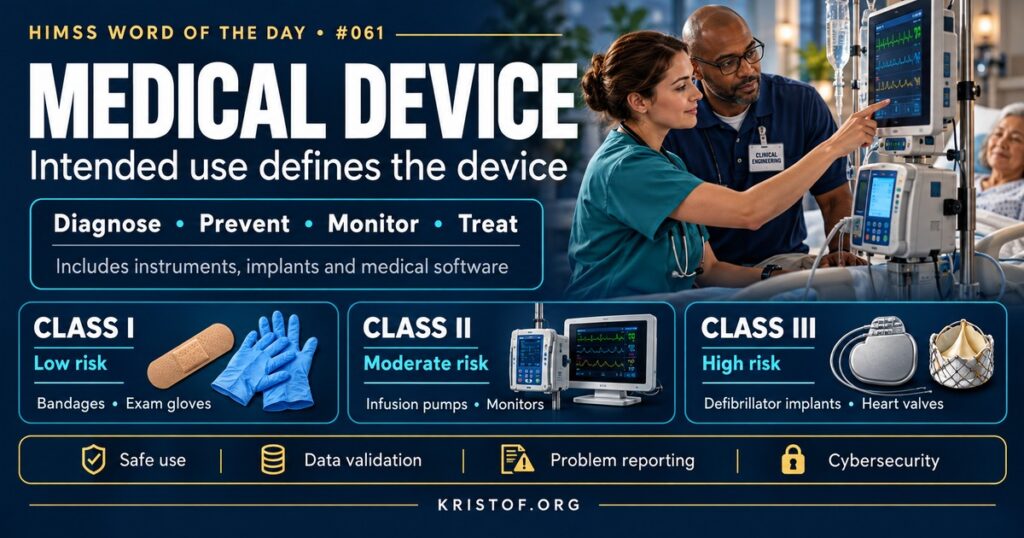
A medical device is a product used to diagnose, prevent, monitor, or treat a disease or injury, or to support or change the body’s structure or function, that works mainly by physical, mechanical, electronic, or software means rather than by acting as a drug.
The HIMSS Dictionary gives a broad, international-style definition. It includes instruments, machines, appliances, implants, in vitro reagents and calibrators, software, and materials that a manufacturer intends for use in people, alone or together, for purposes such as diagnosing, preventing, monitoring, or treating disease or injury; investigating or supporting anatomy and physiological processes; sustaining life; controlling conception; disinfecting other devices; and providing information through laboratory examination of specimens. The defining limit is that the product does not achieve its main effect through pharmacological, immunological, or metabolic action, although such means may assist it.
In the United States, FDA regulates devices according to risk:
| FDA Class | Risk Level | Typical Pathway | Examples |
|---|---|---|---|
| Class I | Low | Most are exempt from premarket review | Elastic bandages, examination gloves, many manual instruments |
| Class II | Moderate | Usually premarket notification, known as a 510(k) | Infusion pumps, many patient monitors, powered wheelchairs |
| Class III | High | Premarket approval (PMA) | Implantable defibrillators, heart valves |
| New Low-to-Moderate Risk Types | Low to moderate, no predicate | De Novo classification request | Some novel digital health and AI tools |
⚠️ Exam Alert: Whether a product is a medical device depends on its intended use, not just its technology. Software as a Medical Device (SaMD) is software that performs a medical purpose on its own, such as analyzing images to detect disease. Software that simply stores or displays records, or supports general wellness, is often outside device regulation. A drug acts through chemical or metabolic means; a combination product includes both a drug and a device.
🌐 Why It Matters: Real-World Healthcare IT Context
Hospitals depend on thousands of medical devices, and more of them are connected to networks and to the EHR every year. Infusion pumps, monitors, ventilators, beds, glucose meters, imaging equipment, and smart wearables all generate data and can affect patient safety directly.
Software has expanded the category. FDA’s Software as a Medical Device framework, developed with international regulators, covers software that diagnoses, treats, or drives clinical management, including many tools that use artificial intelligence. That means some clinical software is reviewed much like a physical device, while other EHR functions are not.
Postmarket safety relies on reporting. FDA’s MedWatch program accepts reports from clinicians and the public, and the MAUDE database collects medical device reports from manufacturers, importers, and user facilities. Under FDA’s medical device reporting rules, hospitals and other user facilities must report device-related deaths, and serious injuries, through defined channels. Recalls and safety communications follow when patterns emerge, and unique device identifiers help organizations find affected devices and patients.
Connected devices also bring cybersecurity risk. Many older devices cannot be patched or run security software, so hospitals segment them on networks, and newer connected devices must include cybersecurity information when manufacturers seek FDA clearance or approval.
Common medical device challenges:
- Device data that does not reach the EHR, forcing manual transcription
- Alarm overload from monitors and pumps with poorly tuned settings
- Legacy devices that cannot receive security updates
- Inconsistent drug libraries or configurations across units
- Malfunctions that go unreported because staff assume someone else will report them
- Incomplete inventories of devices and their software versions
Characteristics of strong device management:
- An accurate inventory maintained with clinical engineering
- Device integration that files validated data to the chart
- Alarm management programs with clinical input
- Clear, easy reporting of device problems and near misses
- Recall workflows linked to purchasing and implant records
- Security assessments before new devices are connected
🏥 The Nurse’s Perspective: Clinical, Bedside, & Workflow
Nurses use medical devices continuously, which makes them the most important observers of how devices perform in real care.
At the Bedside
A typical patient room may hold an infusion pump, a cardiac monitor, a pulse oximeter, a smart bed, sequential compression devices, and a glucose meter. Nurses set up each device, confirm settings, respond to alarms, and document what the device shows. A pump programmed from a drug library and integrated with the EHR reduces manual steps, but nurses still verify the patient, the medication, and the rate.
When a device behaves unexpectedly, such as a pump that alarms repeatedly, a monitor that loses its signal, or a bed that will not lock, the nurse takes it out of service when safety requires it, tags it, and reports it. Keeping the device and its disposables for clinical engineering can help determine what went wrong.
In Clinical Workflow
Device data increasingly flows into flowsheets automatically. Vital signs from monitors and infusion data from pumps can appear in the chart for nurse validation. Validation remains a clinical responsibility, because artifacts from motion, a loose lead, or a disconnected sensor can create values that do not reflect the patient.
Alarm management is a nursing workflow issue as much as a technical one. Default thresholds that are too sensitive add to alarm burden, while thresholds that are too loose can miss deterioration. Nurses’ input helps clinical engineering and informatics teams tune settings safely.
In EHR Implementation (Go-Live Perspective)
During an Epic Go-Live, device integration is often configured for monitors, vital sign machines, and smart pumps. Testing should include real devices on real units, because association steps, such as linking a device to the correct patient, can vary by model and location.
At-the-elbow support analysts often help nurses associate devices with patients, validate incoming data, and understand what to do when data does not appear. Clear escalation to clinical engineering and integration teams keeps device problems from turning into documentation workarounds.
🎓 CAHIMS / CPHIMS & HIMSS Perspective
CAHIMS Exam Domain Mapping
Medical devices appear in regulation, safety, and integration questions:
| CAHIMS Domain | How Medical Devices Appear |
|---|---|
| Healthcare & Technology Environments | FDA definition and classes; Software as a Medical Device; postmarket surveillance |
| Clinical Informatics | Device data in documentation; alarm management; safety reporting |
| Healthcare Information & Systems Management | Device integration, network segmentation, inventory, unique device identifiers |
| Management & Leadership | Procurement and security review, recall response, clinical engineering partnerships |
Key Terms to Know Alongside Medical Device
- Software as a Medical Device (SaMD) — software intended for a medical purpose that functions without being part of a hardware device
- 510(k) — FDA premarket notification showing a device is substantially equivalent to a legally marketed device
- Premarket Approval (PMA) — FDA’s most stringent review pathway, used for high-risk Class III devices
- MAUDE — FDA’s database of medical device reports, including malfunctions, injuries, and deaths
- Unique Device Identifier (UDI) — a code on device labels identifying the device model and, when applicable, its production details
- Device Integration — automatic transfer of data from medical devices into clinical information systems
HIMSS Organizational Position
HIMSS addresses medical devices through its work on connected health, device interoperability, and cybersecurity. Its Healthcare Cybersecurity Community focuses heavily on securing connected medical devices, and its Virtual Care Community covers devices used beyond the hospital. Members can find related education and research through the HIMSS Resource Center.
🔗 Explore Further: External References
- FDA — How to Determine if Your Product Is a Medical Device https://www.fda.gov/medical-devices/classify-your-medical-device/how-determine-if-your-product-medical-device
- FDA — Software as a Medical Device (SaMD) https://www.fda.gov/medical-devices/digital-health-center-excellence/software-medical-device-samd
- FDA — About the MAUDE Database https://www.fda.gov/medical-devices/mandatory-reporting-requirements-manufacturers-importers-and-device-user-facilities/about-manufacturer-and-user-facility-device-experience-maude-database
- FDA — MedWatch Safety Information and Adverse Event Reporting Program https://www.fda.gov/safety/medwatch-fda-safety-information-and-adverse-event-reporting-program
- FDA — Medical Device Cybersecurity https://www.fda.gov/medical-devices/digital-health-center-excellence/cybersecurity
- HIMSS — Healthcare Cybersecurity Community https://www.himss.org/networking/communities/healthcare-cybersecurity/
Term source: HIMSS Dictionary of Health Information and Technology Terms, Acronyms, and Organizations, 6th Edition (2025). All definitions in this series are paraphrased for editorial purposes. Readers are encouraged to consult the primary source for exact language.
Eric Andrew Kristof, RN, CAHIMS is a Healthcare IT professional and HIMSS Arkansas Chapter member based in Hot Springs Village, AR, with hands-on Epic Go-Live experience and a diverse healthcare and IT background. He writes at kristof.org at the intersection of clinical care and healthcare technology.
Leave a Reply