By Eric Andrew Kristof, RN, CAHIMS | Healthcare IT Professional | HIMSS Arkansas Chapter Member
About This Series: The HIMSS Word of the Day is a running blog series drawing from the HIMSS Dictionary of Health Information and Technology Terms, Acronyms, and Organizations, 6th Edition (2025) — the authoritative reference for healthcare IT professionals and the primary study resource for CAHIMS and CPHIMS certification. Each post paraphrases the term in plain language, grounds it in real-world healthcare IT context, and adds a bedside nursing perspective you won’t find in a textbook.
📖 The Term: Wearable Technology
Source: HIMSS Dictionary of Health Information and Technology Terms, Acronyms, and Organizations, 6th Edition (2025)
🔍 Plain-Language Definition
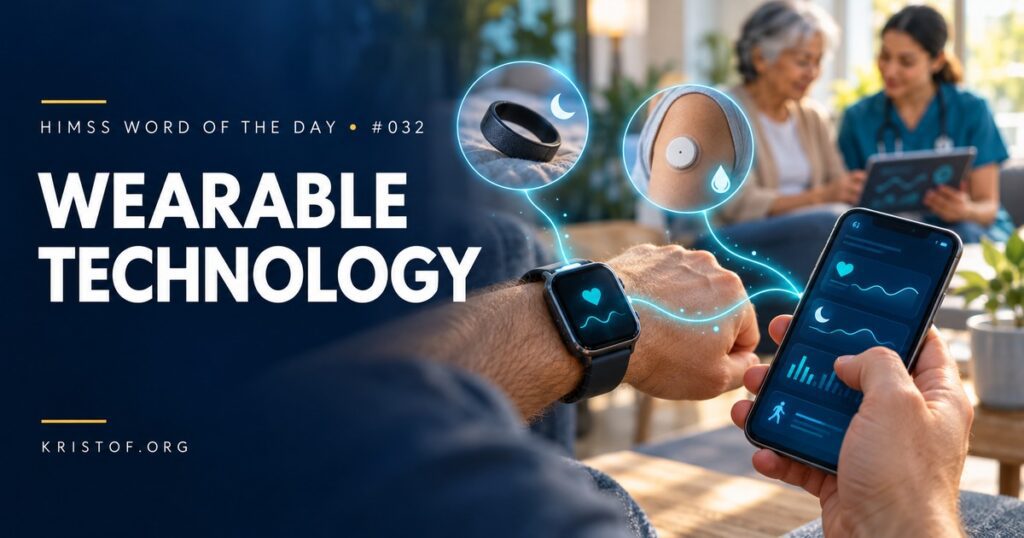
Wearable technology, often shortened to wearables, refers to electronic devices worn on the body, in clothing, or as accessories that collect and report information about the wearer.
The HIMSS Dictionary describes wearables as devices built into clothing or accessories that capture and report behaviors such as physical activity and sleep, with the goal of helping people learn about their habits and move toward healthier ones. That consumer focus is where the category started, with step counters and fitness bands.
The category has since widened. Many wearables now measure physiology, such as heart rate and rhythm, blood oxygen, skin temperature, and glucose levels, and some are regulated medical devices prescribed by clinicians.
| Type | Typical Examples | Who Usually Uses the Data |
|---|---|---|
| Consumer Wellness Wearables | Fitness bands, smartwatches, sleep rings | The individual, sometimes shared with a clinician |
| Consumer Devices with Regulated Features | Smartwatch irregular rhythm notifications or single-lead ECG features | The individual and their clinician |
| Prescription Medical Wearables | Continuous glucose monitors, wearable ECG patches, cardiac event monitors | Clinicians, care managers, and the patient |
| Hospital and Post-Discharge Wearables | Wireless patches that track vital signs continuously | Nursing and monitoring teams |
⚠️ Exam Alert: Wearable technology describes the device form factor. Remote patient monitoring (RPM) is a care program that may use wearables or other home devices. Patient-generated health data (PGHD) is the data patients or their devices create outside clinical settings. The Internet of Medical Things (IoMT) is the broader network of connected medical devices. A single smartwatch can touch all four ideas, but the terms are not interchangeable.
🌐 Why It Matters: Real-World Healthcare IT Context
Wearables move measurement out of the clinic and into daily life. Instead of a single blood pressure or heart rate at an appointment, clinicians can see trends over weeks. That can reveal problems sooner, show how a patient responds to treatment, and support chronic disease programs such as diabetes and heart failure management.
The best-known example of scale is the Apple Heart Study, published in the New England Journal of Medicine in 2019. It enrolled 419,297 participants in eight months. Only 0.52% received an irregular pulse notification. Among notified participants who later wore an ECG patch, 34% had atrial fibrillation on that patch, and when an irregular pulse notification occurred during patch monitoring, it matched atrial fibrillation 84% of the time. The study showed both promise and limits: notifications were uncommon, and a notification was a reason for evaluation rather than a diagnosis.
Regulation depends on intended use. FDA’s general wellness policy explains that low-risk products intended only to support a healthy lifestyle are generally outside its active oversight, while features that claim to detect or manage disease are reviewed as medical devices.
Privacy follows a similar split. HIPAA protects wearable data once it is held by a covered entity, such as a hospital, or its business associate. Data that stays with a consumer device company is generally outside HIPAA and is governed instead by the company’s privacy policy, consumer protection law, and in some cases FTC rules.
Common challenges with wearable data:
- Large volumes of data with no clear owner on the care team
- Variable accuracy between devices and between consumer and medical-grade sensors
- Unclear clinical action thresholds, which can feed alert fatigue
- Data that lives in a vendor app rather than in the EHR
- Uneven access because of cost, connectivity, and digital literacy
- Privacy expectations that patients may not understand
What makes wearable programs work:
- A defined clinical purpose, such as heart failure or post-discharge monitoring
- Medical-grade devices where decisions depend on the data
- Integration that brings summarized trends, not raw streams, into the chart
- Clear responsibility for reviewing data and acting on it
- Patient education on what the device does and does not detect
🏥 The Nurse’s Perspective: Clinical, Bedside, & Workflow
Nurses see wearables on both sides of the hospital doors, as patient-owned devices and as clinical monitoring tools.
At the Bedside
Patients increasingly arrive with smartwatch data or notifications. A patient may report an irregular rhythm alert, a low overnight oxygen reading, or a high resting heart rate. Nurses take those reports seriously while confirming findings with clinical equipment, because consumer devices are not designed to replace a bedside monitor or a 12-lead ECG.
Continuous glucose monitors are now common among patients with diabetes. Nurses need to know their organization’s policy on whether a patient’s own device may stay on during admission, when fingerstick confirmation is required, and how readings are documented.
In Clinical Workflow
On some units, wireless wearable patches track heart rate, respiratory rate, and other signs continuously instead of every four hours. That can catch deterioration sooner, but only if alert thresholds are tuned and someone is assigned to respond. Without that design, continuous data can add to alarm burden instead of reducing risk.
After discharge, remote monitoring nurses often review wearable and home device data on dashboards, call patients when readings fall outside set ranges, and escalate to providers. Their workflow depends on clear protocols for which readings need action and how quickly.
In EHR Implementation (Go-Live Perspective)
During an Epic Go-Live, device integration usually focuses on bedside monitors, infusion pumps, and vital sign machines rather than consumer wearables. The same lessons apply, though. Nurses need to validate device data before it files to the chart, know how to correct a wrong value, and understand what happens when a device disconnects.
At-the-elbow support analysts often field questions about where outside data shows up, such as readings patients submit through the patient portal. Knowing whether a value was measured by staff, filed by a device, or entered by the patient helps nurses judge how much weight to give it.
🎓 CAHIMS / CPHIMS & HIMSS Perspective
CAHIMS Exam Domain Mapping
Wearable technology appears in questions about connected health, data management, and privacy:
| CAHIMS Domain | How Wearables Appear |
|---|---|
| Healthcare & Technology Environments | Consumer health technology trends; FDA oversight; HIPAA applicability; digital equity |
| Clinical Informatics | Remote monitoring workflows; patient-generated health data; alert thresholds; patient education |
| Healthcare Information & Systems Management | Device integration, data volume, interface standards, security of connected devices |
| Management & Leadership | Program design and staffing for data review; reimbursement for remote monitoring; vendor selection |
Key Terms to Know Alongside Wearable Technology
- Remote Patient Monitoring (RPM) — a care program that collects patient data outside traditional settings and sends it to clinicians for review
- Patient-Generated Health Data (PGHD) — health data created, recorded, or gathered by patients or their devices
- mHealth — the use of mobile devices and apps to support health and healthcare
- Internet of Medical Things (IoMT) — the network of connected medical devices, sensors, and software that exchange health data
- Continuous Glucose Monitor (CGM) — a wearable sensor that measures glucose levels at frequent intervals
- General Wellness Product — FDA’s term for low-risk products intended only to maintain or encourage a healthy lifestyle
HIMSS Organizational Position
HIMSS addresses wearables through its work on virtual care and connected health. Its Virtual Care Community brings together professionals working on telehealth, remote monitoring, and digital tools that extend care beyond the hospital. Members can find related education and research through the HIMSS Resource Center.
🔗 Explore Further: External References
- FDA — General Wellness: Policy for Low Risk Devices https://www.fda.gov/regulatory-information/search-fda-guidance-documents/general-wellness-policy-low-risk-devices
- FDA — Digital Health Center of Excellence https://www.fda.gov/medical-devices/digital-health-center-excellence
- Perez et al. (2019), New England Journal of Medicine — Large-Scale Assessment of a Smartwatch to Identify Atrial Fibrillation https://pubmed.ncbi.nlm.nih.gov/31722151/
- ONC — Telemedicine and Telehealth https://healthit.gov/public-health/telemedicine-and-telehealth/
- HHS — Health Information Privacy (HIPAA) https://www.hhs.gov/hipaa/index.html
- HIMSS — Virtual Care Community https://www.himss.org/networking/communities/virtual-care/
Term source: HIMSS Dictionary of Health Information and Technology Terms, Acronyms, and Organizations, 6th Edition (2025). All definitions in this series are paraphrased for editorial purposes. Readers are encouraged to consult the primary source for exact language.
Eric Andrew Kristof, RN, CAHIMS is a Healthcare IT professional and HIMSS Arkansas Chapter member based in Hot Springs Village, AR, with hands-on Epic Go-Live experience and a diverse healthcare and IT background. He writes at kristof.org at the intersection of clinical care and healthcare technology.
Leave a Reply