By Eric Andrew Kristof, RN, CAHIMS | Healthcare IT Professional | HIMSS Arkansas Chapter Member
About This Series: The HIMSS Word of The Day is a running blog series drawing from the HIMSS Dictionary of Health Information and Technology Terms, Acronyms, and Organizations, 6th Edition (2025) — the authoritative reference for healthcare IT professionals and the primary study resource for CAHIMS and CPHIMS certification. Each post paraphrases the term in plain language, grounds it in real-world healthcare IT context, and adds a bedside nursing perspective you won’t find in a textbook.
📖 The Term: LSC (Life Safety Code)
Source: HIMSS Dictionary of Health Information and Technology Terms, Acronyms, and Organizations, 6th Edition (2025)
🔍 Plain-Language Definition
The HIMSS Dictionary describes the Life Safety Code (LSC) as a set of fire protection requirements meant to give health care facilities a reasonable degree of safety from fire. It addresses construction, protective systems, and operating practices intended to guard against fire, smoke, and panic. A companion publication, the Health Care Facilities Code (HCFC), sets minimum requirements for installing, inspecting, testing, maintaining, and safely using facility systems, materials, and equipment. Both come from the National Fire Protection Association (NFPA), an organization founded in 1896, and both are revised on a regular cycle. The LSC is NFPA 101, and the Health Care Facilities Code is NFPA 99.
The codes matter to health IT because they are enforced through the Centers for Medicare & Medicaid Services (CMS). In a final rule effective July 5, 2016, CMS adopted the 2012 edition of the LSC, removed references in its regulations to earlier editions, and adopted the 2012 edition of the Health Care Facilities Code with some exceptions. The rule applied to hospitals, critical access hospitals, long-term care facilities, ambulatory surgery centers, and several other provider types. Surveyors inspect facilities against these requirements, and deficiencies are cited.
How does this reach IT? The Health Care Facilities Code covers systems such as medical gas, vacuum, electrical power, and ventilation. The electrical power that keeps servers, network closets, and bedside devices running, the cooling of machine rooms, and the inspection records for all of these sit inside the same physical environment. Sprinkler or alarm outages, construction projects, and equipment changes also create documentation, scheduling, and communication tasks that facilities and IT teams share. Organizations may track inspection, testing, and maintenance in software, so data quality and access matter.
The LSC differs from cybersecurity rules and from clinical standards, but it shares an organizing idea: safety depends on design, testing, documentation, and trained people.
| Element | Meaning |
|---|---|
| LSC (NFPA 101) | Fire protection requirements for buildings and occupancies |
| HCFC (NFPA 99) | Requirements for health care facility systems and equipment |
| NFPA | National Fire Protection Association, publisher of the codes |
| CMS adoption | Federal rule that makes the codes a condition of participation |
| Survey | Inspection that checks a facility against the codes and cites deficiencies |
⚠️ Exam Alert: The Life Safety Code (LSC) is NFPA 101, the fire protection code for facility construction, protection, and operation. The Health Care Facilities Code is NFPA 99, which covers systems and equipment. Do not confuse the LSC with the HIPAA Security Rule’s physical safeguards, which protect information systems and ePHI, or with the Joint Commission, an accrediting body that surveys against many standards.
🌐 Why It Matters: Real-World Healthcare IT Context
Evidence on the Life Safety Code comes from regulatory documents, nursing practice articles, and studies of survey data. Each source below was checked against its published abstract or the rule text.
The CMS final rule (Federal Register, May 4, 2016) is the primary source for how the codes apply. It states that it will adopt the 2012 edition of the Life Safety Code, eliminate references to earlier editions, and adopt the 2012 edition of the Health Care Facilities Code with some exceptions, effective July 5, 2016. It describes NFPA 99 as a baseline for how facility materials, equipment, and appliances are installed, checked, maintained, and used safely, and notes that some chapters of NFPA 99 would not apply to hospitals.
Scheidel and Vavrinchik, in the Nephrology Nursing Journal (2024), wrote a nurse manager’s guide to the LSC survey process in dialysis facilities. They describe the LSC as a set of components, measures, and protocols intended to protect and preserve life, review survey tasks and the responsibilities of the provider and building management, and discuss best practices for survey readiness. It is a practice article, not a study with outcome data.
Festa and colleagues, in JAMA Network Open (2023), studied nursing homes in coastal Atlantic and Gulf Coast states from 2017 to 2019, using critical emergency preparedness deficiencies cited during CMS life safety code inspections. Of 5,914 nursing homes, 617 (10.4 percent) were at risk of hurricane-related inundation exposure, and 1,763 (29.8 percent) had a critical emergency preparedness deficiency. Exposure was associated with more deficiencies in the Mid-Atlantic region (adjusted odds ratio 1.91) but with fewer in the Western Gulf Coast (adjusted rate ratio 0.55). The authors concluded the association between flood exposure and preparedness varied by region. It is a cross-sectional study, so it describes association at one point in time.
Festa and colleagues, in BMJ Public Health (2026), followed 294 CMS-certified nursing homes exposed to Hurricane Michael in October 2018, with 21,945 residents. In the post-disaster period there were 697 deaths, 1,316 hospitalizations, and 1,274 instances of functional decline. No emergency preparedness deficiency predicted adverse outcomes, but two building code deficiencies from the CMS Life Safety Code survey predicted post-disaster functional decline (incidence rate ratios 1.21 and 1.51). The models showed modest improvements in predictive accuracy that were not statistically significant. The authors conclude that oversight of nursing home emergency preparedness needs better alignment with real-world disaster response. It is a retrospective cohort in one disaster, so it may not apply to other events.
Festa and colleagues, in the Journal of the American Medical Directors Association (2025), analyzed federal nursing home regulation and report substantial differences in patterns of deficiency severity scoring between Standard and Life Safety Code surveys. The abstract is brief, so the specific numbers are best read in the paper.
Taken together, the sources show that the LSC is a formal, survey-enforced framework, that survey findings can be linked to real-world outcomes, and that measuring facility safety is harder than counting citations.
Common Life Safety Code problems:
- Outdated or incomplete inspection, testing, and maintenance records
- Fire doors, sprinklers, or alarms taken out of service without a clear plan
- Construction and renovation that disrupt exits or protective systems
- Unclear coordination between facilities, clinical, and IT teams
- Equipment, cabling, or storage that affects egress or protection
- Preparedness paperwork that does not match actual response capability
What supports LSC compliance:
- A single, current record of inspections, tests, and corrective actions
- Interim life safety plans when protective systems are out of service
- Shared communication between facilities, nursing, and IT
- Staff training and drills tied to the actual building
- Survey readiness reviews before inspections
- Regular review of deficiencies and trends
🏥 The Nurse’s Perspective: Clinical, Bedside, & Workflow
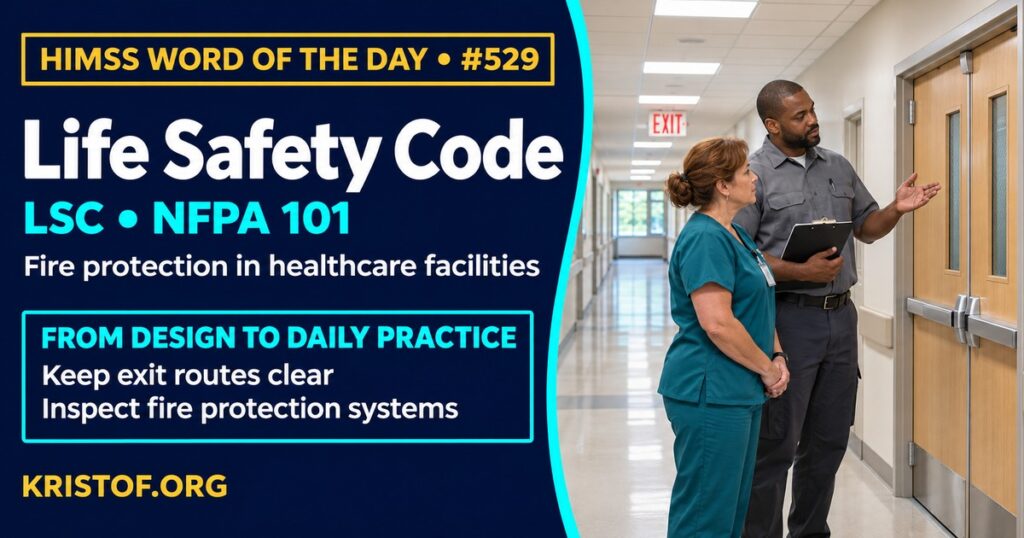
Nurses carry out the daily habits that make the Life Safety Code real: keeping exits clear, knowing the response plan, and moving patients if needed.
At the Bedside
Nurses know where exits, extinguishers, and pull stations are, and they keep corridors and doors free of obstructions. They take part in fire drills and learn the steps for protecting and moving patients, including those who depend on equipment or oxygen. Documentation of drills and observations supports compliance.
In Clinical Workflow
Nurse leaders prepare units for surveys, check that wall hangings, supplies, and equipment placement meet requirements, and report damaged doors or blocked paths. Nurse informaticists can help with downtime procedures when a fire event or system outage affects electronic documentation, so that paper backup is ready and understood.
In EHR Implementation (Go-Live Perspective)
During an Epic Go-Live, extra carts, cables, and temporary workspaces appear on units. Analysts at the elbow and unit leaders coordinate placement so that hallways, exits, and fire equipment stay accessible. Planning for these physical changes ahead of go-live avoids last-minute conflicts with life safety rules.
🎓 CAHIMS / CPHIMS & HIMSS Perspective
CAHIMS Exam Domain Mapping
The Life Safety Code ties the physical environment to regulation and operations:
| CAHIMS Domain | How LSC Appears |
|---|---|
| Healthcare & Technology Environments | Regulations, accreditation, and the physical environment of care |
| Clinical Informatics | Downtime procedures and safe workflow during emergencies |
| Healthcare Information & Systems Management | Power, cooling, equipment placement, and inspection records |
| Management & Leadership | Survey readiness, compliance programs, and emergency planning |
Key Terms to Know Alongside Life Safety Code
- NFPA (National Fire Protection Association) — organization that publishes the LSC and the Health Care Facilities Code
- Health Care Facilities Code — NFPA 99, requirements for facility systems and equipment
- Physical Safeguards — measures that protect information systems and equipment from hazards and intrusion
- Business Continuity Plan — plan to keep critical operations running during a disruption
- Disaster Recovery Plan — plan to restore systems after a disruption
- Accreditation — formal recognition that an organization meets defined standards
HIMSS Organizational Position
HIMSS offers education and research on health information and technology topics through its Resource Center. Members can find related information on the HIMSS Resource Center page.
🧭 More HIMSS Word of The Day Terms
Related terms in the Healthcare Policy series:
- Payer
- QAPI (Quality Assurance and Performance Improvement)
- MDS (Minimum Data Set)
- CMS Promoting Interoperability Programs
Browse all Healthcare Policy terms or the A–Z glossary.
🔗 Explore Further: External References
- Centers for Medicare & Medicaid Services — Medicare and Medicaid Programs; Fire Safety Requirements for Certain Health Care Facilities; Final Rule (Federal Register, May 4, 2016) https://www.federalregister.gov/documents/2016/05/04/2016-10043/medicare-and-medicaid-programs-fire-safety-requirements-for-certain-health-care-facilities
- Scheidel and Vavrinchik (2024), Nephrology nursing journal — Nurse Manager’s Guide to Life Safety Code for Dialysis Facilities https://pubmed.ncbi.nlm.nih.gov/38949802/
- Festa et al. (2023), JAMA network open — Association of Nursing Home Exposure to Hurricane-Related Inundation With Emergency Preparedness https://pubmed.ncbi.nlm.nih.gov/36607635/
- Festa et al. (2026), BMJ public health — Evaluating administrative compliance as a predictor of nursing home postdisaster outcomes in the USA https://pubmed.ncbi.nlm.nih.gov/41561558/
- Festa et al. (2025), Journal of the American Medical Directors Association — Evaluating the Applicability of Federal Regulatory Metrics for Nursing Home Fire Safety and Emergency Preparedness https://pubmed.ncbi.nlm.nih.gov/40882948/
- HIMSS — Resource Center https://www.himss.org/resource-center
Term source: HIMSS Dictionary of Health Information and Technology Terms, Acronyms, and Organizations, 6th Edition (2025). All definitions in this series are paraphrased for editorial purposes. Readers are encouraged to consult the primary source for exact language.
Eric Andrew Kristof, RN, CAHIMS is a Healthcare IT professional and HIMSS Arkansas Chapter member based in Hot Springs Village, AR, with hands-on Epic Go-Live experience and a diverse healthcare and IT background. He writes at kristof.org at the intersection of clinical care and healthcare technology.
Leave a Reply