By Eric Andrew Kristof, RN, CAHIMS | Healthcare IT Professional | HIMSS Arkansas Chapter Member
About This Series: The HIMSS Word of The Day is a running blog series drawing from the HIMSS Dictionary of Health Information and Technology Terms, Acronyms, and Organizations, 6th Edition (2025) — the authoritative reference for healthcare IT professionals and the primary study resource for CAHIMS and CPHIMS certification. Each post paraphrases the term in plain language, grounds it in real-world healthcare IT context, and adds a bedside nursing perspective you won’t find in a textbook.
📖 The Term: Ad Hoc Query
Source: HIMSS Dictionary of Health Information and Technology Terms, Acronyms, and Organizations, 6th Edition (2025)
🔍 Plain-Language Definition
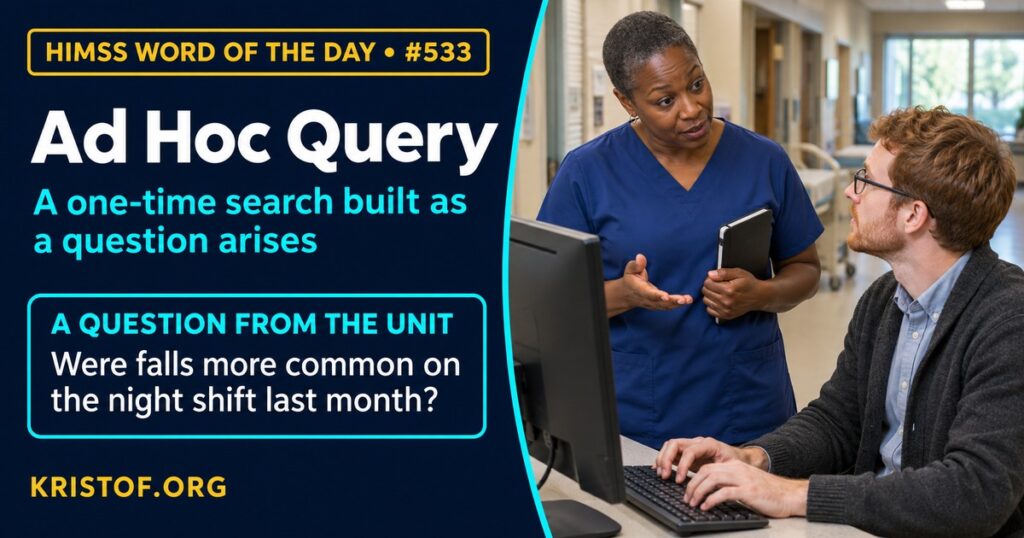
The HIMSS Dictionary gives two linked meanings for ad hoc query. First, it is a query whose form is not fixed ahead of time; it takes shape at the moment someone runs it against a data source. Second, it is a one-off inquiry made to get information as a need arises, which stands in contrast to a query that has been predefined and runs on a regular schedule.
The distinction matters in practice. A predefined report, such as a daily census or a monthly infection rate, is built once, tested, and run the same way every time. An ad hoc query answers a question nobody planned for: How many patients on this unit had a fall after receiving a certain medication? Which clinic patients are overdue for a screening and also have a documented barrier? Ad hoc queries serve researchers looking for cohorts, quality teams investigating a problem, and operational leaders responding to something unexpected.
Because the question is new, ad hoc querying depends on strong underlying data: well-defined tables or data models, clear field meanings, consistent coding, and access controls that expose only what a user is permitted to see. It also depends on tools. Some users write structured query language (SQL) directly. Others use point-and-click query builders in a research platform or reporting tool. Some newer approaches try to translate everyday language into queries.
Ad hoc access carries risks. A new query may be wrong in subtle ways, may count the wrong population, or may expose protected information if access is not controlled. Many organizations therefore pair self-service tools with training, data dictionaries, and review of results before they are used for decisions.
| Feature | Predefined report | Ad hoc query |
|---|---|---|
| When it is defined | Ahead of time | At the moment of use |
| Typical use | Routine monitoring | One-off questions and exploration |
| Validation | Tested once and reused | Needs fresh checking each time |
| Users | Many, with fixed output | Analysts, researchers, trained users |
| Risks | Becomes outdated | Wrong logic, misuse of data |
⚠️ Exam Alert: An ad hoc query is defined at the time it is run, not in advance. A predefined (standard) report is built once and run routinely. Do not confuse ad hoc querying with data mining (pattern discovery across large datasets) or with business intelligence dashboards, which usually present predefined views.
🌐 Why It Matters: Real-World Healthcare IT Context
Studies of query tools look at how researchers and operational users ask questions of EHR data, and what makes those tools work. Each source below was checked against its published abstract.
Sholle and colleagues, in AMIA Joint Summits on Translational Science Proceedings (2020), characterized use of i2b2, a cohort discovery platform, at an academic medical center. Over three years, 609 researchers ran 6,662 queries and requested re-identification of 80 patient cohorts. After classifying queries as basic or complex, they found that most queries, and most of those that led to a request for cohort re-identification, did not use complex features. Data domains that took extensive effort to implement saw relatively little use compared with common domains such as diagnoses. They suggest that making basic queries on common domains perform well may serve researchers better than adding novel domains or complex features. It is a single-institution usage analysis.
Hruby and colleagues, in the Journal of Biomedical Informatics (2016), surveyed approaches that help biomedical researchers interrogate EHR data on their own. Using a conceptual framework from interactive information retrieval, they found that biomedical informatics progress lies mainly in support for query execution and information modeling, through infrastructure and self-service query tools, but has neglected user support during the iterative process of formulating queries, which can be costly and error-prone. They suggest that information science research could help. It is a methods survey, not a test of one tool.
Sholle and colleagues, in the Journal of Biomedical Informatics (2018), addressed a scalability problem with i2b2 when it supports many projects. The standard approach duplicates data across projects. Their view-based approach stored data in a single fact table and used SQL views to serve each project. Compared with the standard approach, it reduced required disk space by 59 percent and extract-transform-load time by 46 percent without substantially affecting query performance. The result comes from one institution’s implementation.
Chamberlin and colleagues, in JAMIA Open (2020), evaluated patient-level retrieval methods for a cohort discovery task. They built a test collection of about 100,000 patient records and 56 test topics and ran automated word-based retrieval under 48 parameter combinations. The best word-based settings reached a mean B-Pref of 0.167. Topic representation had the largest effect, and structured Boolean queries generally performed better than automated ones on recall and precision, although they did not recall all the relevant patients that automated queries found. The authors describe word-based automated methods as attractive but suboptimal.
McPherson and colleagues, in Studies in Health Technology and Informatics (2026), described an analytics education initiative at Unity Health Toronto after a new electronic patient record went live. The program trained front-line operational users to use the built-in self-service reporting tool and pre-built dashboards. The authors report a more than 150-fold rise in dashboard usage, from 90 to over 14,500 monthly views, plus a training program and improved data literacy and decision-making responsiveness. It is a program report, so the outcomes are as the organization describes them.
Taken together, the studies suggest that most ad hoc querying is simple, that supporting query formulation is as important as supporting query execution, and that training and governance are what turn access into useful decisions.
Common ad hoc query problems:
- Users who cannot translate a clinical question into a correct query
- Data domains that are built but rarely used
- Queries that return the wrong population without anyone noticing
- Duplicated data and slow performance as projects multiply
- Dashboards or tools that few people know how to use
- Unclear access rules for sensitive data
What supports effective ad hoc querying:
- Fast, reliable basic queries on common data domains
- Support for iterative query formulation, including examples and feedback
- Data dictionaries that explain what each field means
- Training that builds data literacy among front-line users
- Scalable data design that avoids duplication
- Governance for access, review of results, and privacy
🏥 The Nurse’s Perspective: Clinical, Bedside, & Workflow
Many of the questions nurses and nurse leaders want answered do not fit into a routine report, which is why ad hoc access to data matters.
At the Bedside
Nurses notice patterns before they appear in reports: more falls on a certain shift, a rise in pressure injuries, unusual alarm volumes. Raising these observations with leaders and informatics staff leads to a query that tests whether the pattern is real.
In Clinical Workflow
Nurse informaticists and quality analysts translate clinical questions into data questions. They ask what is meant by a fall, which documentation fields hold the answer, and which patients should be counted. That translation is often the hardest step, as research on query formulation suggests. Well-documented fields and shared definitions make it easier to produce a reliable answer.
In EHR Implementation (Go-Live Perspective)
During an Epic Go-Live, new documentation produces new data, and questions about it start right away: how often is a field used, and are the flowsheets capturing what was intended? Analysts at the elbow help units learn the built-in reporting tools so that managers can explore data themselves, with support for validating what they find.
🎓 CAHIMS / CPHIMS & HIMSS Perspective
CAHIMS Exam Domain Mapping
Ad hoc queries link data, tools, and governance:
| CAHIMS Domain | How Ad Hoc Queries Appear |
|---|---|
| Healthcare & Technology Environments | Data warehouses, research platforms, and reporting tools |
| Clinical Informatics | Translating clinical questions into queries and cohorts |
| Healthcare Information & Systems Management | Data models, performance, access control, and data dictionaries |
| Management & Leadership | Training, data governance, and analytics strategy |
Key Terms to Know Alongside Ad Hoc Query
- SQL (Structured Query Language) — standard language for querying relational databases
- Data Warehouse — repository that integrates data from multiple sources for analysis
- Data Dictionary — documentation of what each data element means
- Cohort Discovery — process of finding groups of patients who meet defined criteria
- Dashboard — visual display of key measures, often predefined
- Data Governance — policies and roles that control how data are managed and used
HIMSS Organizational Position
HIMSS offers education and research on health information and technology topics through its Resource Center. Members can find related information on the HIMSS Resource Center page.
🧭 More HIMSS Word of The Day Terms
Related terms in the Data and Analytics series:
Browse all Data and Analytics terms or the A–Z glossary.
🔗 Explore Further: External References
- Sholle et al. (2020), AMIA Joint Summits on Translational Science proceedings — Characterizing Basic and Complex Usage of i2b2 at an Academic Medical Center https://pubmed.ncbi.nlm.nih.gov/32477681/
- Hruby et al. (2016), Journal of biomedical informatics — Facilitating biomedical researchers’ interrogation of electronic health record data: Ideas from outside of biomedical informatics https://pubmed.ncbi.nlm.nih.gov/26972838/
- Sholle et al. (2018), Journal of biomedical informatics — A scalable method for supporting multiple patient cohort discovery projects using i2b2 https://pubmed.ncbi.nlm.nih.gov/30009991/
- Chamberlin et al. (2020), JAMIA open — Evaluation of patient-level retrieval from electronic health record data for a cohort discovery task https://pubmed.ncbi.nlm.nih.gov/33215074/
- McPherson et al. (2026), Studies in health technology and informatics — Empowering Front-Line Decision Making Through Self-Service Analytics in the Electronic Patient Records System at Unity Health Toronto https://pubmed.ncbi.nlm.nih.gov/41685468/
- HIMSS — Resource Center https://www.himss.org/resource-center
Term source: HIMSS Dictionary of Health Information and Technology Terms, Acronyms, and Organizations, 6th Edition (2025). All definitions in this series are paraphrased for editorial purposes. Readers are encouraged to consult the primary source for exact language.
Eric Andrew Kristof, RN, CAHIMS is a Healthcare IT professional and HIMSS Arkansas Chapter member based in Hot Springs Village, AR, with hands-on Epic Go-Live experience and a diverse healthcare and IT background. He writes at kristof.org at the intersection of clinical care and healthcare technology.
Leave a Reply