By Eric Andrew Kristof, RN, CAHIMS | Healthcare IT Professional | HIMSS Arkansas Chapter Member
About This Series: The HIMSS Word of The Day is a running blog series drawing from the HIMSS Dictionary of Health Information and Technology Terms, Acronyms, and Organizations, 6th Edition (2025) — the authoritative reference for healthcare IT professionals and the primary study resource for CAHIMS and CPHIMS certification. Each post paraphrases the term in plain language, grounds it in real-world healthcare IT context, and adds a bedside nursing perspective you won’t find in a textbook.
📖 The Term: IVR (Interactive Voice Response)
Source: HIMSS Dictionary of Health Information and Technology Terms, Acronyms, and Organizations, 6th Edition (2025)
🔍 Plain-Language Definition
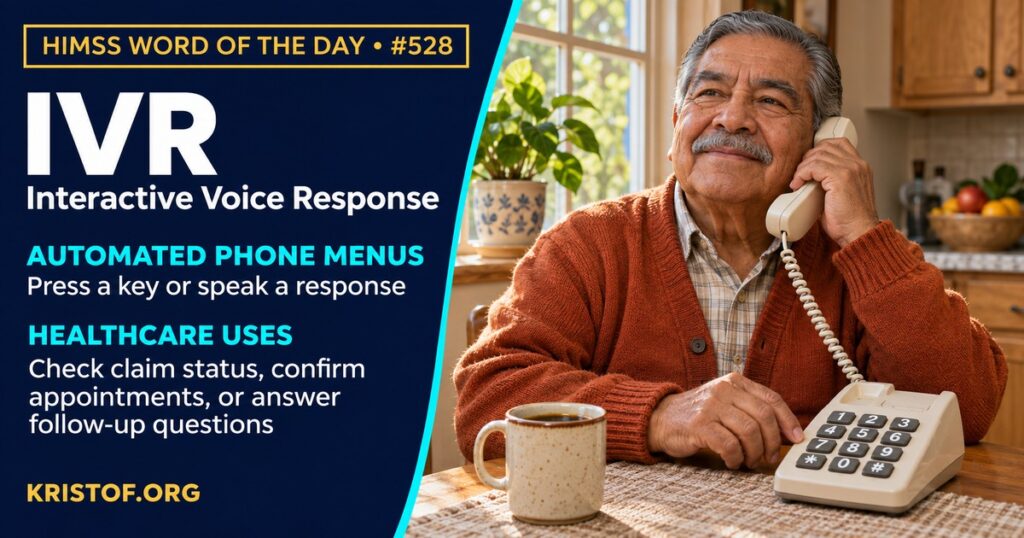
The HIMSS Dictionary describes interactive voice response (IVR) as the ability to reach information by telephone, with payer examples that include what a claim paid, where a claim stands, and whether a patient is eligible for coverage. In plain terms, an IVR is an automated phone system. A caller reaches a menu, responds by pressing keys or speaking, and the system retrieves and reads back information or collects information from the caller, often without a live person.
The dictionary’s examples come from the business side of health care. A provider’s billing staff can call a health plan’s automated line to check whether a claim was paid, where it stands, or whether a patient is covered. Those calls rely on the IVR being linked to the payer’s systems. The same technology is used on the clinical side as well: automated reminders, appointment confirmations, medication refill lines, test result lines, post-discharge check-in calls, and telephone-based symptom or behavior monitoring.
IVR has strengths and limits. It can run around the clock, handle large call volumes, and reach people who do not use smartphones or portals. It can also frustrate callers when menus are long, speech recognition fails, or no human is available. In recent years, voice assistants and artificial intelligence have extended the idea, creating systems that can hold more natural conversations. The core design question remains the same: what information needs to flow by voice, who is on the line, and what happens when the automated path cannot help.
| IVR use | Example |
|---|---|
| Payer inquiry | Check claim status or patient eligibility by phone |
| Patient reminders | Appointment or medication reminder calls |
| Follow-up monitoring | Automated post-discharge or postoperative check-in questions |
| Information line | Test results, hours, or instructions |
| Reporting | Staff report safety events by phone |
⚠️ Exam Alert: IVR (interactive voice response) is a telephone-based automated system that lets callers get or give information through keypad or voice input. Do not confuse it with VoIP (which carries voice over IP networks), voice recognition or dictation (which converts speech to text), or a patient portal (a web-based channel).
🌐 Why It Matters: Real-World Healthcare IT Context
Studies of IVR in health care come mostly from patient-facing uses, with some from staff-facing uses. Each source below was checked against its published abstract.
Tsoli and colleagues, in BMJ Open (2018), reviewed IVR-based interventions designed to change health behaviors. From 2,546 papers identified, they included 15 randomized controlled trials in a random-effects meta-analysis. IVR interventions had small but significant effects on medication adherence (odds ratio 1.527, nine trials) and physical activity (Hedges’ g 0.254, three trials), and no effect on alcohol use or diet. The authors call IVR promising for specific behaviors and note that more robust designs and objective outcome measures are needed. The effects were small, and the literature covered studies published through 2017.
Khan and colleagues, in BMJ Open (2024), systematically reviewed IVR for tobacco cessation. Of 308 abstracts, 20 moderate-quality to low-quality studies were included. IVR was used alone or alongside other treatment, as a treatment, follow-up, or risk-assessment tool. Effective studies found that IVR was delivered more frequently with shorter follow-up times. The authors describe the evidence as weak but IVR as a promising intervention, and point to gaps in population diversity, settings, and patient and provider perspectives.
McNiven and colleagues, in the Joint Commission Journal on Quality and Patient Safety (2021), applied IVR to staff incident reporting in a diagnostic imaging department in Ontario. A survey found the most common barriers to reporting were lack of time, complexity of the system, and lack of feedback. A phone-based structured IVR was then tested department-wide. Reports per day were significantly higher with the IVR (mean 3.43) than with the web-based system (mean 0.99), and the average time to report was 97 seconds, compared with 644 seconds. It is a single-department study, so it shows feasibility rather than a guaranteed result elsewhere.
Ayala-Ortiz and colleagues, in Applied Clinical Informatics (2025), piloted an IVR for postoperative monitoring in 24 patients undergoing primary total joint arthroplasty, randomly assigned to 12 receiving IVR calls and 12 receiving standard follow-up. The IVR group had a 92.3 percent retention rate and 100 percent completion of the 12-week study, an 81 percent response rate to calls, and 92 percent of patients found the calls “very useful.” IVR calls triggered 10 notifications for issues such as pain control and respiratory concerns, leading to timely interventions that the authors say prevented emergency department visits. The sample was small, and the pilot measured feasibility and acceptability rather than clinical effect.
Ganni and colleagues, in the Journal of Cardiovascular Translational Research (2023), surveyed people after they were screened for SARS-CoV-2 exposure by an artificially intelligent IVR system on an Amazon Echo Show 8 in cardiovascular clinics. Of 215 people enrolled in screening, 58 consented to the survey. Four themes affected acceptability: difficulties with communication (44.8 percent), limits of interaction modes (41.4 percent), barriers to therapeutic relationships (25.9 percent), and concerns about universality and accessibility (8.6 percent). The authors say the systems appeared to be well accepted. The survey sample was small, so the percentages describe those respondents.
Taken together, the sources show that automated phone systems can support adherence, follow-up, and reporting, that evidence quality is mixed, and that design and accessibility shape how people respond.
Common IVR problems:
- Long or confusing menus that frustrate callers
- Speech recognition errors, accents, or background noise
- No easy route to a live person when needed
- Limited access for people with hearing, language, or technology barriers
- Alerts from automated calls that no one reviews quickly
- Weak integration with the systems that hold the answers
What supports effective IVR:
- Short, clear menus tested with real callers
- A visible path to a human at any point
- Clinical protocols for what happens when a call flags a problem
- Integration with the EHR, scheduling, or payer systems
- Language and accessibility options
- Regular review of call data and caller feedback
🏥 The Nurse’s Perspective: Clinical, Bedside, & Workflow
For nurses, IVR shows up as a tool that extends contact with patients and as a first stop in the phone path to the clinic.
At the Bedside
Patients leaving the hospital may receive automated reminders or follow-up calls, and nurses explain what those calls are and why they matter. Patients who report symptoms through an automated call expect that someone will follow up, so clear instructions on what happens next build trust.
In Clinical Workflow
Nurse informaticists and call center nurses help set the protocols for automated follow-up: which questions are asked, which answers trigger a callback, and who reviews alerts. A well-designed IVR sends the right answers to the right nurse at the right time. A poorly designed one adds noise or misses concerning replies. On the business side, patient access and revenue cycle staff use payer IVR lines to check coverage and claim status.
In EHR Implementation (Go-Live Perspective)
Patient-facing phone workflows, such as appointment reminders, callback queues, and automated messages, are often part of go-live readiness. During an Epic Go-Live, analysts at the elbow hear about confusing phone prompts and missing callbacks from front-line staff, which helps identify what to adjust.
🎓 CAHIMS / CPHIMS & HIMSS Perspective
CAHIMS Exam Domain Mapping
IVR touches patient access, communication, and business operations:
| CAHIMS Domain | How IVR Appears |
|---|---|
| Healthcare & Technology Environments | Telephony, payer systems, and patient communication channels |
| Clinical Informatics | Automated follow-up, monitoring protocols, and alert review |
| Healthcare Information & Systems Management | Integration, availability, and call data management |
| Management & Leadership | Service design, vendor selection, and patient access strategy |
Key Terms to Know Alongside IVR
- VoIP — voice communication carried over internet protocol networks
- Voice Recognition — computer conversion of spoken words into text or commands
- Eligibility Verification — checking whether a patient is covered by a health plan
- Patient Portal — secure web-based channel for patients to access their health information
- Call Center — team and systems that handle incoming and outgoing patient calls
- Remote Patient Monitoring — collection of patient data outside the clinic for review by clinicians
HIMSS Organizational Position
HIMSS offers education and research on health information and technology topics through its Resource Center. Members can find related information on the HIMSS Resource Center page.
🧭 More HIMSS Word of The Day Terms
Related terms in the Connected Health series:
Browse all Connected Health terms or the A–Z glossary.
🔗 Explore Further: External References
- Tsoli et al. (2018), BMJ open — Interactive voice response interventions targeting behaviour change: a systematic literature review with meta-analysis and meta-regression https://pubmed.ncbi.nlm.nih.gov/29478016/
- Khan et al. (2024), BMJ open — Interactive voice response (IVR) for tobacco cessation: a systematic review https://pubmed.ncbi.nlm.nih.gov/38986561/
- McNiven et al. (2021), Joint Commission journal on quality and patient safety — Novel Telephone-Based Interactive Voice Response System for Incident Reporting https://pubmed.ncbi.nlm.nih.gov/34732307/
- Ayala-Ortiz et al. (2025), Applied clinical informatics — An Interactive Voice Response System for Postoperative Care in Primary Total Joint Arthroplasty Patients: A Pilot Study https://pubmed.ncbi.nlm.nih.gov/39952287/
- Ganni et al. (2023), Journal of cardiovascular translational research — Attitudes About Artificially Intelligent Interactive Voice Response Systems Using Amazon Alexa in Cardiovascular Clinics: Insights from the VOICE-COVID-19 Study https://pubmed.ncbi.nlm.nih.gov/36749563/
- HIMSS — Resource Center https://www.himss.org/resource-center
Term source: HIMSS Dictionary of Health Information and Technology Terms, Acronyms, and Organizations, 6th Edition (2025). All definitions in this series are paraphrased for editorial purposes. Readers are encouraged to consult the primary source for exact language.
Eric Andrew Kristof, RN, CAHIMS is a Healthcare IT professional and HIMSS Arkansas Chapter member based in Hot Springs Village, AR, with hands-on Epic Go-Live experience and a diverse healthcare and IT background. He writes at kristof.org at the intersection of clinical care and healthcare technology.
Leave a Reply