By Eric Andrew Kristof, RN, CAHIMS | Healthcare IT Professional | HIMSS Arkansas Chapter Member
About This Series: The HIMSS Word of The Day is a running blog series drawing from the HIMSS Dictionary of Health Information and Technology Terms, Acronyms, and Organizations, 6th Edition (2025) — the authoritative reference for healthcare IT professionals and the primary study resource for CAHIMS and CPHIMS certification. Each post paraphrases the term in plain language, grounds it in real-world healthcare IT context, and adds a bedside nursing perspective you won’t find in a textbook.
📖 The Term: URL (Uniform Resource Locator)
Source: HIMSS Dictionary of Health Information and Technology Terms, Acronyms, and Organizations, 6th Edition (2025)
🔍 Plain-Language Definition
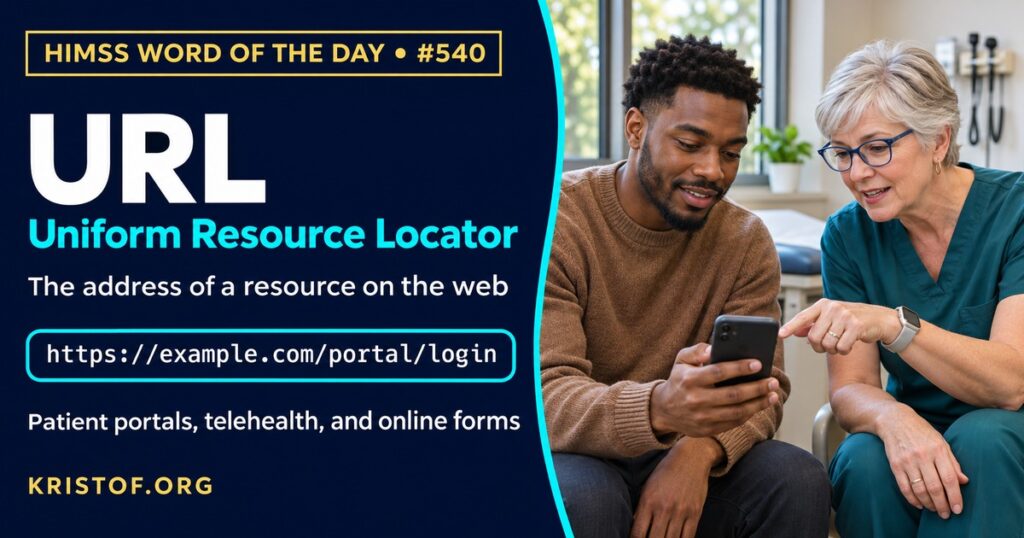
The HIMSS Dictionary describes a URL (Uniform Resource Locator) as the address that tells software where a resource on the web is found. It combines the name of the protocol used to reach the resource with the name of the resource itself.
In everyday use, a URL is what appears in a browser’s address bar or behind a link in an email, a portal, or a document. The standard that defines the syntax, RFC 3986 by Berners-Lee, Fielding, and Masinter (2005), explains that a URL is a subset of the broader class of uniform resource identifiers (URIs). A URI identifies a resource. A URL goes further by also describing the primary access mechanism for it, such as its network location. The same standard says that future documentation should prefer the general term URI over the narrower terms URL and URN, even though “URL” remains the common word in daily use and in the HIMSS Dictionary.
A URL follows a generic structure. It starts with a scheme, which names the protocol or mechanism, such as https. Next comes an authority, which usually includes the host (the server’s name) and may include a port. A path then points to the resource on that host. An optional query can pass extra details, and an optional fragment can point to a place inside the resource. Because each part has a job, a small change in a URL can send a user to a different page or to none at all.
For health IT, URLs are everywhere. Patient portals, telehealth visits, online forms, education materials, order set links, research citations, and appointment reminders all depend on them. That makes three practical questions important: Will the link still work later? Is the link safe? And can the people who need it actually use what it opens?
| Part | Role | Example |
|---|---|---|
| Scheme | Names the protocol or access method | https |
| Host | Names the server | example.com |
| Path | Points to the resource on the host | /portal/login |
| Query | Passes optional details | ?lang=es |
| Fragment | Points to a spot within the resource | #billing |
⚠️ Exam Alert: A URL locates a resource by giving its protocol and name. A URI is the broader class that identifies a resource, and a URL is the subset that also tells software how to reach it. Do not confuse a URL with a domain name (only the host part), an IP address (a numeric network address), or a hyperlink (the clickable element that contains a URL).
🌐 Why It Matters: Real-World Healthcare IT Context
Studies that mention URLs in health care cover three practical themes: links that stop working, links that are used for attacks, and links that open resources some patients cannot use. Each source below was checked against its published abstract or the standard itself, and the type of study is noted.
Wren and colleagues, in Nucleic Acids Research (2017), studied URLs found in MEDLINE abstracts that pointed to bioinformatics resources such as programs, web servers, and databases. They note that earlier studies found roughly 27 percent of such URLs had decayed. They used crowdsourcing and the Internet Archive’s Wayback Machine to approximate when resources disappeared. The most cited resources were 94 percent likely to be relocated to another URL, compared with 34 percent of uncited ones. After accounting for relocation, citations were the strongest predictors of continued availability, after time since publication. The authors conclude that URL decay is a general, persistent phenomenon. The resources studied were scientific tools rather than health care operations.
Howell and Burtis, in the Journal of the Medical Library Association (2022), updated a 2009 study of URL decay in health care management journals. They collected URLs of web-based references from articles in five journals published from 2016 to 2018 and checked whether each was still active. Availability differed by publication date, resource type, and top-level domain. Domains with the highest share of unavailable URLs were .com and .net, and the lowest were .edu and .gov. Older citations were more likely to be unavailable. The overall share of unavailable URLs fell from 49.3 percent to 36.1 percent between the two studies. The authors say decay remains a problem and recommend digital object identifiers and web archiving.
Ott, in JSLS (2022), checked whether references could be retrieved in articles published in 2019 and 2020 in one surgical journal. Among 95 articles with 2,424 references, 357 (14.7 percent) were unavailable because of bad, broken, or nonexistent links, the wrong article, abstract- or citation-only access, or missing citations. The author calls loss of retrievability a scientific hazard. The unavailable group includes causes other than broken links, and the sample is from a single journal.
Su and Su, in Sensors (2023), described a model that uses BERT to read URL strings and classify them as malicious or not. The authors note that malicious URLs are common in cyberattacks, especially phishing aimed at stealing sensitive information or distributing malware. On three public datasets, the model achieved accuracy of 98.78, 96.71, and 99.98 percent. The datasets were general web data rather than health care data, and accuracy on benchmark datasets does not guarantee the same performance in a hospital’s email system.
Chen and colleagues, in JAMA Network Open (2025), examined language accessibility of hospital patient portals. For hospitals in 51 counties across 17 states, selected for large populations with limited English proficiency, they recorded each portal’s URL and checked its login page. Of 514 eligible hospitals, 511 had public-facing portals. The login page was available in English only at 150 hospitals (29.4 percent), in English and Spanish only at 305 (59.7 percent), and in at least one more language at 56 (10.9 percent). Only 24 of 511 (4.7 percent) offered access in the most common non-English, non-Spanish language of their county. Teaching hospitals had higher odds of multilingual login pages than nonteaching hospitals, while hospitals whose vendor was not Epic MyChart or Cerner had lower odds. It is a cross-sectional study of the login prompt, not of the whole portal.
Taken together, the sources show that a URL is only as reliable as the page behind it, that links can be used to deceive, and that a working link is not enough if patients cannot read what it opens.
Common URL problems:
- Links that break or move after publication
- References and education materials that point to pages that no longer exist
- Phishing links that look legitimate
- Portal and form links that open pages in only one language
- Long or complex URLs that are hard to read or type
- Links placed in documents without anyone responsible for checking them
What supports reliable use of URLs:
- Persistent identifiers such as digital object identifiers, where available
- Web archiving of cited pages
- Regular checking of links in education materials and order sets
- Staff training and tools for spotting suspicious links
- Multilingual login pages and instructions for patient-facing links
- A named owner for each important link
🏥 The Nurse’s Perspective: Clinical, Bedside, & Workflow
Nurses open, share, and explain links throughout a shift, often without thinking of them as URLs.
At the Bedside
Nurses direct patients to portal pages, education sites, and telehealth visit links. A link that is out of date or opens in a language the patient cannot read delays care. The portal study suggests that language access at the login page is a real barrier, so nurses and interpreters may need to help patients get started.
In Clinical Workflow
Nurse informaticists keep an eye on links embedded in order sets, patient education, policies, and training materials. When a page moves, a clinician may reach a dead end at the point of need. Assigning an owner to each link and checking it on a schedule reduces surprises. Staff also benefit from reminders about checking where a link leads before opening it in an email, given the role of malicious URLs in phishing.
In EHR Implementation (Go-Live Perspective)
During an Epic Go-Live, analysts at the elbow field reports of links that fail, open the wrong page, or are blocked by network rules. They trace the cause to the link itself, the content owner, or security settings, and they note which links need a permanent fix before the go-live team steps back.
🎓 CAHIMS / CPHIMS & HIMSS Perspective
CAHIMS Exam Domain Mapping
URLs connect web standards, security, and patient access:
| CAHIMS Domain | How URLs Appear |
|---|---|
| Healthcare & Technology Environments | Web standards, patient portals, and online services |
| Clinical Informatics | Links in order sets, education, and clinical content |
| Healthcare Information & Systems Management | Link management, content governance, and security tools |
| Management & Leadership | Policy for link ownership, staff training, and patient access strategy |
Key Terms to Know Alongside URL
- URI (Uniform Resource Identifier) — broader class of strings that identify a resource
- Domain Name — the readable name of a host, one part of a URL
- Hyperlink — clickable element that leads to a URL
- Phishing — attack that uses deceptive messages or links to steal information
- Digital Object Identifier (DOI) — persistent identifier for a digital resource
- Patient Portal — secure website or app that gives patients access to health information
HIMSS Organizational Position
HIMSS offers education and research on health information and technology topics through its Resource Center. Members can find related information on the HIMSS Resource Center page.
🧭 More HIMSS Word of The Day Terms
Related terms in the Interoperability and Standards series:
- Application Programming Interface (API)
- ISO/IEEE 11073 Standards
- MedDRA (Medical Dictionary for Regulatory Activities)
- MeSH (Medical Subject Headings)
Browse all Interoperability and Standards terms or the A–Z glossary.
🔗 Explore Further: External References
- Berners-Lee et al. (2005), Internet Engineering Task Force — RFC 3986: Uniform Resource Identifier (URI): Generic Syntax https://www.rfc-editor.org/rfc/rfc3986
- Wren et al. (2017), Nucleic acids research — Use it or lose it: citations predict the continued online availability of published bioinformatics resources https://pubmed.ncbi.nlm.nih.gov/28334982/
- Howell and Burtis (2022), Journal of the Medical Library Association — The continued problem of URL decay: an updated analysis of health care management journal citations https://pubmed.ncbi.nlm.nih.gov/37101927/
- Ott (2022), JSLS — Reference Hygiene and Death on the Internet – Decay, Rot, Half-Life, Deterioration, and Corruption https://pubmed.ncbi.nlm.nih.gov/35281707/
- Su and Su (2023), Sensors — BERT-Based Approaches to Identifying Malicious URLs https://pubmed.ncbi.nlm.nih.gov/37896591/
- Chen et al. (2025), JAMA network open — Language Barriers and Access to Hospital Patient Portals in the US https://pubmed.ncbi.nlm.nih.gov/41100083/
- HIMSS — Resource Center https://www.himss.org/resource-center
Term source: HIMSS Dictionary of Health Information and Technology Terms, Acronyms, and Organizations, 6th Edition (2025). All definitions in this series are paraphrased for editorial purposes. Readers are encouraged to consult the primary source for exact language.
Eric Andrew Kristof, RN, CAHIMS is a Healthcare IT professional and HIMSS Arkansas Chapter member based in Hot Springs Village, AR, with hands-on Epic Go-Live experience and a diverse healthcare and IT background. He writes at kristof.org at the intersection of clinical care and healthcare technology.
Leave a Reply