By Eric Andrew Kristof, RN, CAHIMS | Healthcare IT Professional | HIMSS Arkansas Chapter Member
About This Series: The HIMSS Word of The Day is a running blog series drawing from the HIMSS Dictionary of Health Information and Technology Terms, Acronyms, and Organizations, 6th Edition (2025) — the authoritative reference for healthcare IT professionals and the primary study resource for CAHIMS and CPHIMS certification. Each post paraphrases the term in plain language, grounds it in real-world healthcare IT context, and adds a bedside nursing perspective you won’t find in a textbook.
📖 The Term: Outbreak Management (OM)
Source: HIMSS Dictionary of Health Information and Technology Terms, Acronyms, and Organizations, 6th Edition (2025)
🔍 Plain-Language Definition
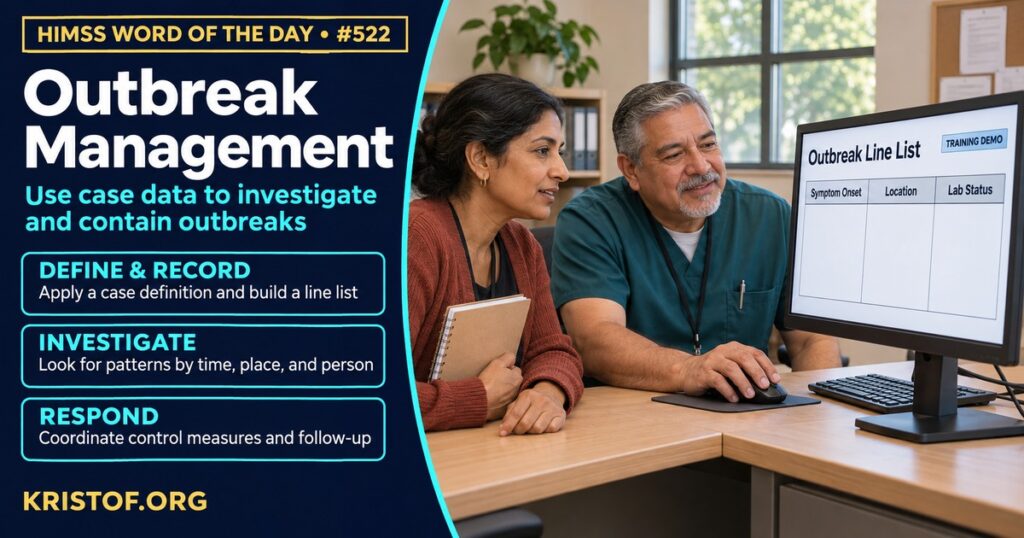
The HIMSS Dictionary describes outbreak management (OM) as the capture and handling of information that comes with investigating and containing a disease outbreak or public health emergency. The emphasis is on information. Epidemiologists and infection preventionists do the investigating, but the work depends on records: who is sick, when symptoms began, where the person was, what tests were run, and what control steps followed.
The CDC Field Epidemiology Manual defines an outbreak as more cases of disease than expected in a given area or among a specific group over a particular time. Its chapter on field investigation lays out ten steps, from preparing for field work and confirming the diagnosis to implementing control measures and communicating findings. Several steps are data tasks. Investigators compare current case counts with an expected baseline, apply a case definition, record cases in a line list, and then tabulate them by time, place, and person, often with an epidemic curve and spot map. The manual also notes that the case definition is often broad at the start and narrowed later, and that investigators must follow privacy laws because outbreak work collects personal information.
An outbreak management capability, whether a purpose-built system or a set of spreadsheets, supports those tasks. It may receive laboratory and clinical data, hold the line list, track contacts, show clusters, and share information with partners. In a hospital, the setting is often a health care-associated infection cluster; in a health department, it may be a community-wide event or a broader public health emergency.
| Outbreak task | Information needed |
|---|---|
| Detect | Case counts compared with an expected baseline |
| Define cases | Clinical, laboratory, time, and place criteria |
| Record | A line list with one row per case |
| Describe | Time, place, and person patterns |
| Control and evaluate | Interventions, follow-up surveillance, and results |
| Communicate | Briefings, reports, and notifications to partners |
⚠️ Exam Alert: Outbreak management is the capture and management of information for investigating and containing an outbreak or public health emergency. Do not confuse it with biosurveillance, which is ongoing monitoring to detect threats, or with contact tracing, which is one activity inside a response. A line list is a case-level table, while an epidemic curve is a graph of cases over time.
🌐 Why It Matters: Real-World Healthcare IT Context
Studies of outbreak information tools range from app reviews to hospital detection systems. Each source below was checked against its published abstract, and the CDC page was read directly.
Quinn and colleagues, in JMIR Public Health and Surveillance (2021), systematically reviewed web-based apps for surveillance and response to acute communicable disease outbreaks in the community. Searching four databases for papers from January 1998 to October 2019, they retrieved 6,649 papers and kept 23, which described 15 apps. The apps were mostly designed to improve early detection and aimed at government settings. The authors found a need for more features supporting secure information exchange and outbreak response actions. Six of the 15 apps had evaluation studies, mostly cross-sectional, with some evidence of reduced time to notification, but the studies lacked user-based needs assessments and evaluation of implementation. The review’s search ended in 2019, before the COVID-19 pandemic.
Dubiniecki and colleagues, in Health Promotion and Chronic Disease Prevention in Canada (2022), described the development of the Canadian Armed Forces Surveillance and Outbreak Management System (CAF SOMS). They write that the COVID-19 pandemic exposed limits in public health data infrastructure and the need for a real-time, centralized, user-friendly data management system for both surveillance and outbreak management. The paper covers development, formative evaluation results, and lessons learned. It is a description of one organization’s system, so the findings may not apply to civilian health departments or hospitals.
DeWitt and Wierzba, in Biology Methods and Protocols (2023), proposed an algorithm that uses hospital electronic health record data to identify case clusters during an infectious disease outbreak. The approach uses Bayesian probabilistic case linking and is intended to supplement outbreak response when human contact tracing resources are limited. The paper presents a method and analysis rather than a deployed tool, so it shows what may be possible, not what is routinely in use.
Sundermann and colleagues, in Clinical Infectious Diseases (2022), evaluated a system called EDS-HAT that combines whole-genome sequencing surveillance with machine learning on the EHR. From November 2016 to November 2018, the team sequenced 3,165 isolates, of which 2,752 were unique patient isolates. Sequencing found 99 clusters involving 297 patient isolates (10.8 percent), ranging from 2 to 14 patients, and at least one transmission route was identified for 65.7 percent of clusters. During the same time, traditional infection prevention investigation prompted sequencing for 15 suspected outbreaks involving 133 patients, and transmission events were identified for 5 of them (3.8 percent). The authors estimated that 25 to 63 transmissions could have been prevented had the system run in real time, with modeled savings of $192,408 to $692,532. Those prevention and savings figures are estimates, not observed results.
Taken together, the sources show that outbreak management rests on accurate case data, timely detection, and tools that fit the people using them. They also show that evidence for many tools remains early-stage.
Common outbreak management problems:
- Case data held in separate spreadsheets, systems, or paper forms
- Delays between a signal and verification by a person
- Case definitions that change without clear version control
- Tools built for detection but weak on response actions and secure sharing
- Limited evaluation of usability and implementation
- Privacy and access rules that are unclear during an emergency
What supports effective outbreak management:
- A shared line list and data dictionary agreed before an event
- Automatic detection with human verification of signals
- Clear case definition versions and change tracking
- Secure exchange with laboratories, clinicians, and public health partners
- User-centered design and training for the people entering data
- Evaluation after each response to capture lessons learned
🏥 The Nurse’s Perspective: Clinical, Bedside, & Workflow
Nurses and infection preventionists are often the first to notice that something is unusual, and they supply much of the data that outbreak management depends on.
At the Bedside
Nurses see patterns before they appear in reports: several patients with similar symptoms on one unit, a cluster of positive tests, or a sudden rise in isolation precautions. Accurate documentation of symptom onset, exposures, room location, and precautions gives investigators the details they need. Prompt reporting to infection prevention is the first link in the chain.
In Clinical Workflow
Infection preventionists review lab results, screening data, and unit census to find and describe cases. Nurse informaticists help by building reports and lists that pull the right fields from the record, and by making sure flowsheet entries, isolation orders, and lab results are captured consistently. During a response, nurses on the unit often handle added screening, cohorting, and visitor rules, so clear communication of the case definition matters.
In EHR Implementation (Go-Live Perspective)
During an Epic Go-Live, analysts at the elbow can see whether the fields needed for infection tracking are easy to find and complete. Missing or hidden fields, free-text workarounds, and unclear isolation documentation are the kinds of build issues that surface quickly. Fixing them before the next outbreak is far easier than building a report under pressure.
🎓 CAHIMS / CPHIMS & HIMSS Perspective
CAHIMS Exam Domain Mapping
Outbreak management combines public health, clinical data, and operations:
| CAHIMS Domain | How Outbreak Management Appears |
|---|---|
| Healthcare & Technology Environments | Public health agencies, surveillance, and reporting requirements |
| Clinical Informatics | Case definitions, line lists, and EHR-based detection |
| Healthcare Information & Systems Management | Data integration, access control, and secure exchange |
| Management & Leadership | Emergency planning, roles, and communication |
Key Terms to Know Alongside Outbreak Management
- Case Definition — criteria used to decide who counts as a case in an investigation
- Line List — table of cases with one row per person and columns for key variables
- Epidemic Curve — graph of the number of cases over time
- Biosurveillance — ongoing monitoring of health data to detect threats early
- Contact Tracing — identifying and following people exposed to a case
- Health Care-Associated Infection — infection acquired during health care delivery
HIMSS Organizational Position
HIMSS offers education and research on health information and technology topics through its Resource Center. Members can find related information on the HIMSS Resource Center page.
🧭 More HIMSS Word of The Day Terms
Related terms in the Clinical Informatics series:
- Point-of-Care System
- LIP (Licensed Independent Practitioner)
- Clinical Informaticist
- Digital Radiography
Browse all Clinical Informatics terms or the A–Z glossary.
🔗 Explore Further: External References
- Quinn et al. (2021), JMIR public health and surveillance — Web-Based Apps for Responding to Acute Infectious Disease Outbreaks in the Community: Systematic Review https://pubmed.ncbi.nlm.nih.gov/33881406/
- Dubiniecki et al. (2022), Health promotion and chronic disease prevention in Canada: research, policy and practice — Development and formative evaluation of the Canadian Armed Forces Surveillance and Outbreak Management System (CAF SOMS): applications for COVID-19 and beyond https://pubmed.ncbi.nlm.nih.gov/35262310/
- DeWitt and Wierzba (2023), Biology methods & protocols — Automatic case cluster detection using hospital electronic health record data https://pubmed.ncbi.nlm.nih.gov/37016667/
- Sundermann et al. (2022), Clinical infectious diseases — Whole-Genome Sequencing Surveillance and Machine Learning of the Electronic Health Record for Enhanced Healthcare Outbreak Detection https://pubmed.ncbi.nlm.nih.gov/34791136/
- CDC — Conducting a Field Investigation (CDC Field Epidemiology Manual, Chapter 3) https://www.cdc.gov/field-epi-manual/php/chapters/field-investigation.html
- HIMSS — Resource Center https://www.himss.org/resource-center
Term source: HIMSS Dictionary of Health Information and Technology Terms, Acronyms, and Organizations, 6th Edition (2025). All definitions in this series are paraphrased for editorial purposes. Readers are encouraged to consult the primary source for exact language.
Eric Andrew Kristof, RN, CAHIMS is a Healthcare IT professional and HIMSS Arkansas Chapter member based in Hot Springs Village, AR, with hands-on Epic Go-Live experience and a diverse healthcare and IT background. He writes at kristof.org at the intersection of clinical care and healthcare technology.
Leave a Reply