By Eric Andrew Kristof, RN, CAHIMS | Healthcare IT Professional | HIMSS Arkansas Chapter Member
About This Series: The HIMSS Word of the Day is a running blog series drawing from the HIMSS Dictionary of Health Information and Technology Terms, Acronyms, and Organizations, 6th Edition (2025) — the authoritative reference for healthcare IT professionals and the primary study resource for CAHIMS and CPHIMS certification. Each post paraphrases the term in plain language, grounds it in real-world healthcare IT context, and adds a bedside nursing perspective you won’t find in a textbook.
📖 The Term: Unique Device Identifier (UDI)
Source: HIMSS Dictionary of Health Information and Technology Terms, Acronyms, and Organizations, 6th Edition (2025)
🔍 Plain-Language Definition
A unique device identifier (UDI) is a code printed on a medical device’s label, in both human-readable text and a barcode or other machine-readable form, that identifies exactly which device it is. For many devices, it also identifies the specific production lot or serial number.
The HIMSS Dictionary describes the UDI as a numeric or alphanumeric code made of two parts. The device identifier (DI) is the required, unchanging portion that identifies the labeler and the particular model or version of the device. The production identifier (PI) is the variable portion, included when it appears on the label, that can carry the lot or batch, serial number, expiration date, manufacturing date, and, for certain human cell and tissue products regulated as devices, a distinct identification code.
| UDI Component | What It Contains | Why It Matters |
|---|---|---|
| Device Identifier (DI) | Labeler and specific model or version | Looks up device details in FDA’s database |
| Lot or Batch Number | Production group the device came from | Finds affected devices in a recall |
| Serial Number | The individual unit | Tracks one specific implant or device |
| Expiration Date | When the device should no longer be used | Prevents use of expired products |
| Manufacturing Date | When the device was made | Supports investigations and recalls |
⚠️ Exam Alert: The UDI is the complete code on the label. The DI identifies the model; the PI identifies the production unit. GUDID (Global Unique Device Identification Database) is FDA’s database of DI information, searchable through AccessGUDID. An NDC identifies drugs, not devices. FDA-accredited issuing agencies, such as GS1, HIBCC, and ICCBBA, define the formats used to create UDIs.
🌐 Why It Matters: Real-World Healthcare IT Context
Before the UDI system, medical devices were identified inconsistently. Manufacturers used their own catalog numbers, hospitals recorded devices in free text, and recalls often meant manual chart reviews to figure out which patients received an affected product.
FDA’s UDI rule, finalized in 2013 and phased in over several years by device risk class, requires labelers of most devices to place a UDI on labels and packages. The UDI must appear in plain text and in an automatic identification and data capture (AIDC) form, such as a barcode, so it can be scanned directly into electronic records. Labelers also submit key device information to GUDID, which the public can search through AccessGUDID, hosted by the National Library of Medicine.
Health IT carries UDIs into patient care. ONC’s certification program includes an implantable device list criterion, requiring certified EHRs to record UDIs for implanted devices, parse the identifier, and retrieve device details. USCDI includes unique device identifiers for a patient’s implantable devices, so this information can be exchanged between systems.
Data completeness is the hidden challenge. A UDI captured with only the device identifier tells a hospital which model was used but not which lot, which limits its value in a targeted recall. A complete scan stored only in a supply chain system may never reach the patient’s chart. Connecting supply chain, perioperative documentation, and the EHR implant list is what turns a barcode into a lasting safety record.
UDIs support many uses beyond recalls: adverse event reporting, supply chain management, inventory and expiration tracking, cost analysis, and research on device performance.
Common UDI challenges:
- Devices recorded by typing catalog numbers instead of scanning
- Barcodes that are hard to scan on small or curved packaging
- Supply systems and EHRs that store device data separately
- Implant records missing production identifiers needed for recalls
- Outside implants with no UDI recorded in the receiving organization’s EHR
- Inconsistent use of UDIs in claims and registries
Characteristics of strong UDI practice:
- Scanning UDIs at the point of use, especially for implants
- Integration between supply chain systems and the EHR implant record
- Automatic lookup of device details from the DI
- Implant information visible in the patient’s chart and summary
- Recall workflows that search by DI, lot, and serial number
- Patient implant cards and portal access to implant information
🏥 The Nurse’s Perspective: Clinical, Bedside, & Workflow
Perioperative and procedural nurses capture most implant UDIs, which makes their scanning practice a foundation of device safety.
At the Bedside
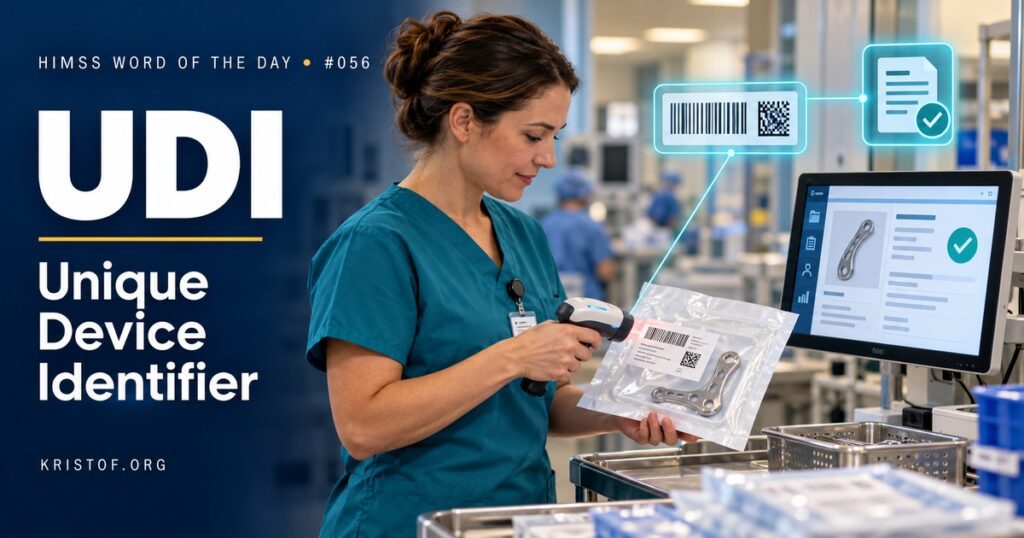
In the operating room or catheterization lab, the circulating nurse scans each implant’s packaging as it is opened and used. The scan records the device, its lot or serial number, and its expiration date in the intraoperative record. Typing the information instead risks errors that can make the patient impossible to identify during a future recall.
Device information also matters long after surgery. Nurses screening patients for MRI safety, preparing for procedures, or responding to device alarms benefit when implant details are documented clearly in the chart.
Patients benefit too. Many implants come with a patient implant card, and nurses can encourage patients to keep it and share it with future providers, especially before imaging or procedures at other facilities.
In Clinical Workflow
Recalls depend on the quality of that original documentation. When a manufacturer recalls a lot of devices, risk management and supply chain teams search records by DI, lot, and serial number to identify affected patients, and nurses may be involved in contacting patients and coordinating follow-up.
Supplies outside the operating room carry UDIs too. Some organizations scan devices such as infusion sets or wound vacuum components for inventory and charging, connecting clinical documentation with supply chain systems.
In EHR Implementation (Go-Live Perspective)
During an Epic Go-Live, perioperative build includes implant documentation, barcode scanner configuration, and integration with supply chain and charging systems. Testing should include scanning real packaging, because barcode formats vary by manufacturer and some packages contain several codes.
At-the-elbow support analysts in surgical areas often help nurses with scanning devices that do not recognize a barcode, documenting an implant manually when necessary, and confirming that implants appear correctly on the patient’s record. Recording these scanning problems helps supply chain and build teams fix them before they become routine workarounds.
🎓 CAHIMS / CPHIMS & HIMSS Perspective
CAHIMS Exam Domain Mapping
UDIs appear in standards, device safety, and supply chain questions:
| CAHIMS Domain | How UDIs Appear |
|---|---|
| Healthcare & Technology Environments | FDA UDI rule; issuing agencies; device safety and recalls |
| Clinical Informatics | Implant documentation, point-of-use scanning, MRI and procedure safety |
| Healthcare Information & Systems Management | ONC implantable device list criterion, USCDI, GUDID lookups, supply chain integration |
| Management & Leadership | Recall response, supply chain strategy, cost tracking, device performance analysis |
Key Terms to Know Alongside UDI
- Device Identifier (DI) — the fixed portion of the UDI that identifies the labeler and device model or version
- Production Identifier (PI) — the variable portion of the UDI, such as lot, serial number, and dates
- GUDID — FDA’s Global Unique Device Identification Database containing key device information
- AIDC (Automatic Identification and Data Capture) — technology such as barcodes that lets data be captured by scanning
- Implantable Device List — the EHR function that records UDIs for devices implanted in a patient
- Issuing Agency — an FDA-accredited organization that operates a system for assigning UDIs
HIMSS Organizational Position
HIMSS addresses medical device identification as part of interoperability and patient safety, including how device data connects with EHRs and supply chain systems. Members can find related education and research through the HIMSS Resource Center.
🔗 Explore Further: External References
- FDA — Unique Device Identification System (UDI System) https://www.fda.gov/medical-devices/device-advice-comprehensive-regulatory-assistance/unique-device-identification-system-udi-system
- FDA — UDI Basics https://www.fda.gov/medical-devices/unique-device-identification-system-udi-system/udi-basics
- FDA — Contact an FDA-Accredited Issuing Agency https://www.fda.gov/medical-devices/unique-device-identification-system-udi-system/contact-fda-accredited-issuing-agency
- National Library of Medicine — AccessGUDID https://accessgudid.nlm.nih.gov/
- ONC — Implantable Device List (Certification Criterion) https://healthit.gov/test-method/implantable-device-list/
- GS1 US — Healthcare Standards https://www.gs1us.org/industries-and-insights/healthcare
Term source: HIMSS Dictionary of Health Information and Technology Terms, Acronyms, and Organizations, 6th Edition (2025). All definitions in this series are paraphrased for editorial purposes. Readers are encouraged to consult the primary source for exact language.
Eric Andrew Kristof, RN, CAHIMS is a Healthcare IT professional and HIMSS Arkansas Chapter member based in Hot Springs Village, AR, with hands-on Epic Go-Live experience and a diverse healthcare and IT background. He writes at kristof.org at the intersection of clinical care and healthcare technology.
Leave a Reply