By Eric Andrew Kristof, RN, CAHIMS | Healthcare IT Professional | HIMSS Arkansas Chapter Member
About This Series: The HIMSS Word of the Day is a running blog series drawing from the HIMSS Dictionary of Health Information and Technology Terms, Acronyms, and Organizations, 6th Edition (2025) — the authoritative reference for healthcare IT professionals and the primary study resource for CAHIMS and CPHIMS certification. Each post paraphrases the term in plain language, grounds it in real-world healthcare IT context, and adds a bedside nursing perspective you won’t find in a textbook.
📖 The Term: Remote Patient Monitoring (RPM)
Source: HIMSS Dictionary of Health Information and Technology Terms, Acronyms, and Organizations, 6th Edition (2025)
🔍 Plain-Language Definition
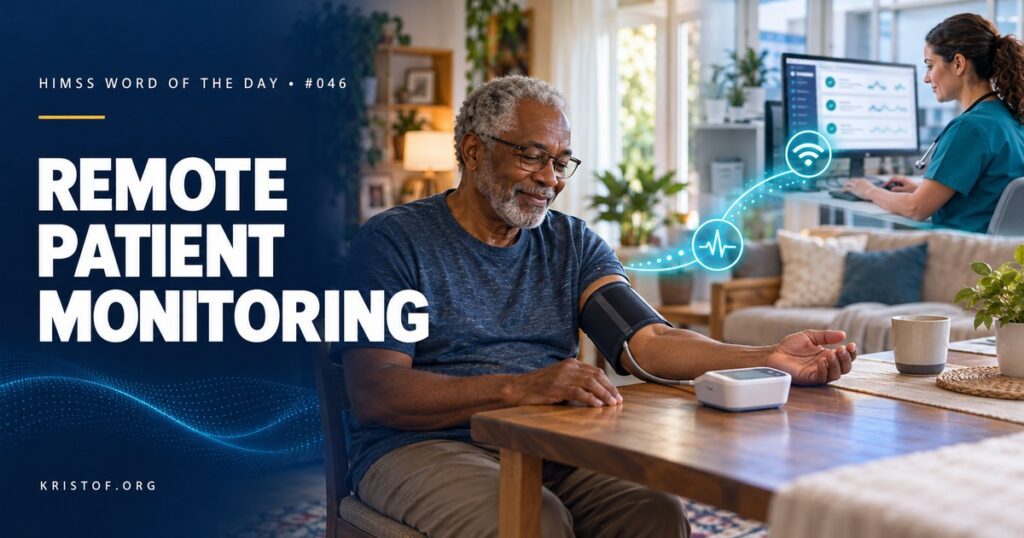
Remote patient monitoring (RPM) is a way of caring for patients between visits by collecting health readings at home, such as blood pressure, weight, oxygen saturation, or blood glucose, and sending them electronically to a care team that reviews them and responds.
The HIMSS Dictionary places RPM within home telehealth. It describes patients using connected medical devices or other technology to collect patient-generated health data and transmit it to clinicians. It also describes RPM more broadly as digital technology that gathers medical and other health information from a person in one place and securely sends it to providers somewhere else, who assess it and make recommendations.
An RPM program has four essential parts:
| Component | What Happens | Example |
|---|---|---|
| Enrollment and Education | The patient is selected, consents, and learns to use the device | A nurse teaches a heart failure patient to weigh daily at the same time |
| Data Collection | Devices capture readings and transmit them, often by cellular connection | A Bluetooth or cellular scale and blood pressure cuff |
| Review and Triage | Clinicians review readings and alerts against set thresholds | A nurse reviews a dashboard of out-of-range readings each morning |
| Response and Treatment | The care team contacts the patient and adjusts care | A diuretic change after a three-pound overnight weight gain |
⚠️ Exam Alert: RPM is a care model for monitoring physiologic data at a distance. Telehealth is the broader umbrella, including live video visits. Store-and-forward telehealth sends recorded data or images for later review. Wearable technology describes a device form factor that RPM may or may not use. Medicare also distinguishes RPM from remote therapeutic monitoring (RTM), which tracks non-physiologic data such as therapy adherence or pain.
🌐 Why It Matters: Real-World Healthcare IT Context
Chronic conditions such as heart failure, hypertension, diabetes, and COPD often worsen gradually. Weight creeps up, blood pressure trends higher, or oxygen levels slip for days before a patient calls for help. RPM gives clinicians a chance to see those trends early and intervene at home.
Evidence is strongest when programs are well designed and targeted. The TIM-HF2 randomized trial, published in The Lancet in 2018, enrolled 1,571 heart failure patients in Germany. Patients in a structured remote patient management program, with daily data transmission and a staffed telemedicine center, lost a smaller percentage of days to unplanned cardiovascular hospitalization and death than patients in usual care, about 17.8 days per year compared with 24.2.
RPM has also grown rapidly in Medicare, which has drawn oversight. A 2024 report from the HHS Office of Inspector General found that Medicare RPM use increased dramatically between 2019 and 2022, and that about 43% of enrollees who received RPM did not receive all three components of the service, raising questions about whether monitoring was being used as intended. OIG recommended stronger oversight, including better information about who orders monitoring and why.
Privacy and security travel with the data. Readings collected by a provider’s RPM program, or by a vendor working for that provider under a business associate agreement, are protected health information under HIPAA. Home devices and companion apps also add new connection points that security teams must account for.
Health IT challenges are significant. Readings may live in a vendor platform instead of the EHR, alert thresholds may be generic, and the volume of incoming data can overwhelm staff if programs grow without planning.
Common RPM pitfalls:
- Enrolling patients without a clear clinical goal
- Devices that are hard to use or depend on home internet the patient does not have
- Readings that are collected but not reviewed promptly
- Generic thresholds that generate too many alerts
- Data stored outside the EHR, invisible to other clinicians
- Billing-driven programs that skip education or treatment management
Characteristics of effective RPM programs:
- Targeted conditions and populations with defined outcomes
- Cellular-enabled devices and simple setup for patients
- Individualized alert thresholds and escalation protocols
- Dedicated nursing staff with clear review schedules
- Integration of summarized readings into the EHR
- Ongoing evaluation of readmissions, outcomes, and patient experience
🏥 The Nurse’s Perspective: Clinical, Bedside, & Workflow
Nurses are the engine of most RPM programs, from enrollment to escalation.
At the Bedside
RPM often starts at discharge. A nurse explains the program, sets up the devices, and teaches the patient and caregiver how and when to take readings. Teach-back is especially important here: a patient who weighs after breakfast one day and before breakfast the next will generate misleading trends.
Choosing the right patients matters as much as choosing the right devices. Nurses often notice when a patient lacks the dexterity, vision, or support at home to use a device reliably, and those observations help programs adjust equipment or involve a caregiver.
Nurses also explain what monitoring is not. RPM is not an emergency service, and patients need clear instructions about when to call 911 instead of waiting for a nurse to review a reading.
In Clinical Workflow
Remote monitoring nurses typically work from dashboards that sort patients by alert severity. They review out-of-range readings, call patients to assess symptoms, check medication adherence, and escalate to providers using standing protocols. Their documentation records what was reviewed, what action was taken, and how much time was spent, because those details support both care and billing.
Alert design shapes the workload. Thresholds that are too sensitive create the same alarm burden seen on inpatient units, while thresholds that are too loose miss deterioration. Programs work best when nurses help tune thresholds for individual patients.
In EHR Implementation (Go-Live Perspective)
During an Epic Go-Live, RPM may involve connecting a vendor platform to the EHR so readings file to flowsheets or appear in summary views. Teams decide which readings come across, how patient-generated data is labeled, and which work queues receive alerts.
At-the-elbow support analysts may help ambulatory and care management nurses find RPM data in the new system and route readings to the right team. Clear labeling of home readings versus clinic measurements helps every clinician interpret the numbers correctly.
🎓 CAHIMS / CPHIMS & HIMSS Perspective
CAHIMS Exam Domain Mapping
RPM appears in connected health, policy, and workflow questions:
| CAHIMS Domain | How RPM Appears |
|---|---|
| Healthcare & Technology Environments | Telehealth policy; Medicare coverage and oversight; chronic disease trends |
| Clinical Informatics | Monitoring workflows, alert thresholds, escalation protocols, patient education |
| Healthcare Information & Systems Management | Device connectivity, data integration, security of home devices, vendor platforms |
| Management & Leadership | Program design, staffing models, outcome measurement, compliance with billing rules |
Key Terms to Know Alongside RPM
- Patient-Generated Health Data (PGHD) — health data created or recorded by patients or their devices outside clinical settings
- Telehealth — the use of electronic information and telecommunications to support remote clinical care and health services
- Store-and-Forward — telehealth that transmits recorded information or images for later review
- Remote Therapeutic Monitoring (RTM) — monitoring of non-physiologic data such as therapy adherence or response
- Alert Threshold — a defined value that triggers review or escalation when a reading falls outside it
- Care Management — coordinated services that help patients manage chronic conditions and navigate care
HIMSS Organizational Position
HIMSS supports RPM and related virtual care through its Virtual Care Community, which brings together clinicians and technology leaders working on telehealth, remote monitoring, and care at home, and through its policy work on telehealth coverage. Members can find related education and research through the HIMSS Resource Center.
🔗 Explore Further: External References
- HHS Office of Inspector General (2024) — Additional Oversight of Remote Patient Monitoring in Medicare Is Needed https://oig.hhs.gov/reports/all/2024/additional-oversight-of-remote-patient-monitoring-in-medicare-is-needed/
- Koehler et al. (2018), The Lancet — Telemedical Interventional Management in Heart Failure (TIM-HF2) https://pubmed.ncbi.nlm.nih.gov/30153985/
- ONC — Telemedicine and Telehealth https://healthit.gov/public-health/telemedicine-and-telehealth/
- CMS — Physician Fee Schedule https://www.cms.gov/medicare/payment/fee-schedules/physician
- FDA — Digital Health Center of Excellence https://www.fda.gov/medical-devices/digital-health-center-excellence
- HIMSS — Virtual Care Community https://www.himss.org/networking/communities/virtual-care/
Term source: HIMSS Dictionary of Health Information and Technology Terms, Acronyms, and Organizations, 6th Edition (2025). All definitions in this series are paraphrased for editorial purposes. Readers are encouraged to consult the primary source for exact language.
Eric Andrew Kristof, RN, CAHIMS is a Healthcare IT professional and HIMSS Arkansas Chapter member based in Hot Springs Village, AR, with hands-on Epic Go-Live experience and a diverse healthcare and IT background. He writes at kristof.org at the intersection of clinical care and healthcare technology.
Leave a Reply