By Eric Andrew Kristof, RN, CAHIMS | Healthcare IT Professional | HIMSS Arkansas Chapter Member
About This Series: The HIMSS Word of the Day is a running blog series drawing from the HIMSS Dictionary of Health Information and Technology Terms, Acronyms, and Organizations, 6th Edition (2025) — the authoritative reference for healthcare IT professionals and the primary study resource for CAHIMS and CPHIMS certification. Each post paraphrases the term in plain language, grounds it in real-world healthcare IT context, and adds a bedside nursing perspective you won’t find in a textbook.
📖 The Term: Admission, Discharge, and Transfer (ADT)
Source: HIMSS Dictionary of Health Information and Technology Terms, Acronyms, and Organizations, 6th Edition (2025)
🔍 Plain-Language Definition
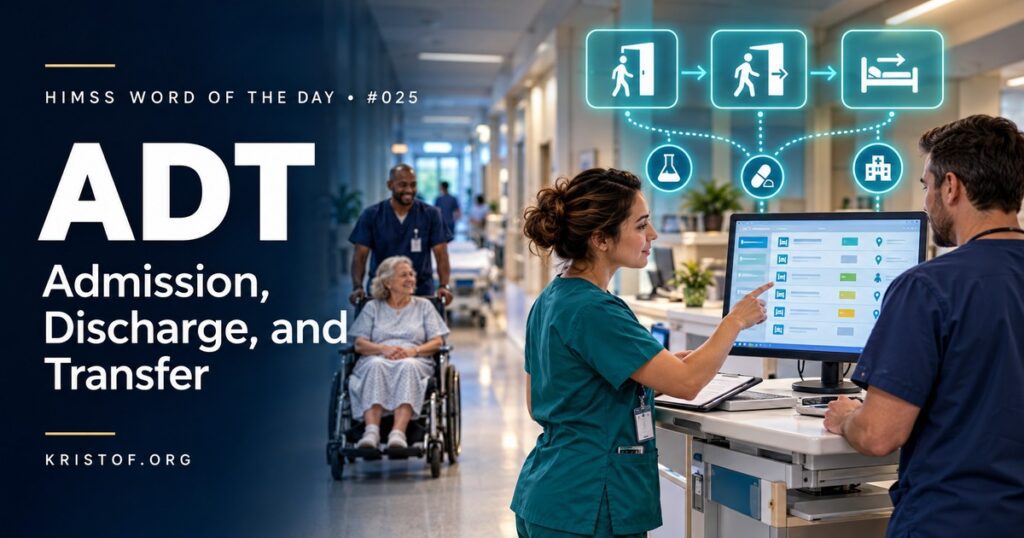
ADT stands for Admission, Discharge, and Transfer, the electronic messages a hospital’s registration system sends whenever a patient is admitted, moved, discharged, or has registration details changed. The HIMSS Dictionary’s entry is brief: ADT refers to the message used for a patient’s admission, discharge, and transfer within a healthcare facility.
That one line understates how much depends on it. ADT messages are how every other system learns who the patient is, where the patient is, and what kind of encounter is underway. Lab, pharmacy, radiology, dietary, bed management, nurse call, billing, and many medical device systems all listen to the ADT feed.
Most ADT traffic uses HL7 Version 2 messages, each identified by a trigger event code:
| HL7 v2 Event | Meaning | What It Tells Downstream Systems |
|---|---|---|
| A01 | Admit or visit notification | A patient has been admitted; create the encounter |
| A02 | Transfer | The patient moved to a new unit, room, or bed |
| A03 | Discharge or end visit | The encounter has ended |
| A04 | Register a patient | An outpatient or emergency registration has occurred |
| A08 | Update patient information | Demographics, insurance, or encounter details changed |
| A11 / A13 | Cancel admit / cancel discharge | A previous event was entered in error and is being reversed |
| A40 | Merge patient identifiers | Duplicate patient records are being combined |
⚠️ Exam Alert: ADT is the classic example of an HL7 v2 message type. Expect questions that match event codes to meanings, especially A01 (admit), A02 (transfer), A03 (discharge), and A08 (update). Distinguish ADT messages from order messages (ORM or OML) and result messages (ORU). And know that ADT feeds are the foundation for event notifications, which CMS requires hospitals to send to a patient’s established providers.
🌐 Why It Matters: Real-World Healthcare IT Context
ADT is usually the first interface an implementation team builds and the last one anyone can afford to lose. If an admission message does not arrive, the lab system cannot accept the specimen, pharmacy cannot verify orders for that encounter, and dietary has no record of the patient. If a transfer message is delayed, a patient can appear on the old unit’s worklist while physically sitting on the new one.
ADT also crosses organizational lines. Under the CMS Interoperability and Patient Access Final Rule, hospitals participating in Medicare must send electronic notifications when patients are admitted, discharged, or transferred to the patient’s established primary care providers and other practitioners and post-acute providers the patient identifies. Those notifications, built on ADT data, let care managers call a patient within days of discharge, which is central to reducing readmissions in value-based programs.
Public health uses ADT data too. Many emergency departments send ADT-based messages to public health agencies for syndromic surveillance, which lets health departments spot unusual patterns, such as a spike in respiratory illness or overdoses, in close to real time. The same admission and discharge events that move a patient through the hospital help protect the surrounding community.
ADT is also evolving. FHIR represents the same information through resources such as Patient and Encounter, and newer approaches let systems subscribe to encounter changes instead of receiving every message. For the foreseeable future, though, HL7 v2 ADT remains the workhorse inside most hospitals.
Failure modes of ADT feeds:
- Duplicate patient records created at registration, fragmenting the record
- Late or out-of-order messages that leave systems with the wrong location or status
- Errors corrected in one system but not propagated to others
- Interface queues that back up silently until someone notices missing results
- Overnight downtime or failover events that drop messages
- Inconsistent encounter types that confuse billing and quality reporting
Strengths of mature ADT operations:
- Strong registration practices and a well-governed enterprise master patient index
- Interface engine monitoring with alerts for queue backlogs and failed messages
- Clear procedures for cancel, correction, and merge events
- Regular reconciliation between the EHR census and downstream systems
- Event notifications routed to the care teams who can act on them
🏥 The Nurse’s Perspective: Clinical, Bedside, & Workflow
Nurses rarely see an ADT message, but they see its effects on every admission, transfer, and discharge.
At the Bedside
When a patient arrives on a unit, the transfer event is what moves the patient onto the nurse’s worklist, puts the medications on the right eMAR, and routes alarms and nurse call to the right staff. A transfer recorded in the EHR before the patient actually moves, or long after, creates a gap in which orders, results, and alerts go to the wrong place.
Wrong-patient risks also begin at registration. A patient registered as a new record instead of matched to an existing one may arrive with no allergy history, no prior results, and a second medical record number on the wristband.
In Clinical Workflow
Nursing workflows sit on top of ADT events. Admission triggers admission assessments and nursing tasks. Transfer triggers handoff and medication reconciliation. Discharge triggers the after-visit summary, discharge teaching, and in many systems, the patient’s transition to follow-up programs.
Timing matters. Nurses who discharge a patient in the EHR promptly free the bed for the next admission and start the clock on downstream notifications. Delays ripple through bed management, emergency department boarding, and transport.
In EHR Implementation (Go-Live Perspective)
During an Epic Go-Live, ADT is part of the cutover’s critical path. The current census must be converted into the new system, every inpatient must have an accurate location, and every downstream system must receive the right encounters before orders begin flowing. Interface teams typically test ADT scenarios extensively, including transfers, cancellations, merges, and leave-of-absence events.
End-user support analysts at the elbow often see ADT problems as clinical complaints: a patient who is missing from the unit list, a lab that will not accept a specimen, or a medication that does not appear after transfer. Recognizing that these symptoms can share an ADT cause, and routing them to the interface team quickly, prevents a small registration problem from becoming a safety event.
🎓 CAHIMS / CPHIMS & HIMSS Perspective
CAHIMS Exam Domain Mapping
ADT appears in CAHIMS questions about standards, interfaces, and workflow:
| CAHIMS Domain | How ADT Appears |
|---|---|
| Healthcare & Technology Environments | HL7 v2 messaging; CMS event notification requirements; standards development organizations |
| Clinical Informatics | Admission, transfer, and discharge workflows; patient identification and safety; transitions of care |
| Healthcare Information & Systems Management | Interface engines; message monitoring; master patient index; downstream system integration |
| Management & Leadership | Patient flow and capacity management; registration quality; cutover planning |
Key Terms to Know Alongside ADT
- HL7 Version 2 — the widely used healthcare messaging standard that defines ADT, order, and result messages
- Interface Engine — middleware that routes, translates, and monitors messages between systems
- Enterprise Master Patient Index (EMPI) — the system that maintains a single identity for each patient across systems
- Event Notification — an electronic alert sent to providers when a patient is admitted, discharged, or transferred
- Encounter — a single interaction between a patient and a healthcare organization, created by ADT events
- Care Transitions — the movement of patients between settings, where ADT-driven communication is critical
HIMSS Organizational Position
HIMSS supports interoperability as a core priority and engages with federal agencies on rules that rely on ADT data, such as event notifications. Its Continuity of Care Maturity Model addresses how organizations share information as patients move across settings, and members can find related guidance through the HIMSS Resource Center.
🔗 Explore Further: External References
- HL7 International — HL7 Version 2 Product Suite https://www.hl7.org/implement/standards/product_brief.cfm?product_id=185
- CMS — Interoperability and Patient Access Final Rule (CMS-9115-F) https://www.cms.gov/initiatives/burden-reduction/overview/interoperability/policies-regulations/cms-interoperability-patient-access-final-rule-cms-9115-f
- ONC — Interoperability Standards Platform https://isp.healthit.gov/
- ONC — What Is HIE? https://healthit.gov/health-it-basics/hie/
- CMS — Interoperability https://www.cms.gov/initiatives/burden-reduction/overview/interoperability
- HIMSS — Digital Maturity Models for Healthcare https://www.himss.org/maturity-models
Term source: HIMSS Dictionary of Health Information and Technology Terms, Acronyms, and Organizations, 6th Edition (2025). All definitions in this series are paraphrased for editorial purposes. Readers are encouraged to consult the primary source for exact language.
Eric Andrew Kristof, RN, CAHIMS is a Healthcare IT professional and HIMSS Arkansas Chapter member based in Hot Springs Village, AR, with hands-on Epic Go-Live experience and a diverse healthcare and IT background. He writes at kristof.org at the intersection of clinical care and healthcare technology.
Leave a Reply