By Eric Andrew Kristof, RN, CAHIMS | Healthcare IT Professional | HIMSS Arkansas Chapter Member
About This Series: The HIMSS Word of the Day is a running blog series drawing from the HIMSS Dictionary of Health Information and Technology Terms, Acronyms, and Organizations, 6th Edition (2025) — the authoritative reference for healthcare IT professionals and the primary study resource for CAHIMS and CPHIMS certification. Each post paraphrases the term in plain language, grounds it in real-world healthcare IT context, and adds a bedside nursing perspective you won’t find in a textbook.
📖 The Term: Data Governance
Source: HIMSS Dictionary of Health Information and Technology Terms, Acronyms, and Organizations, 6th Edition (2025)
🔍 Plain-Language Definition
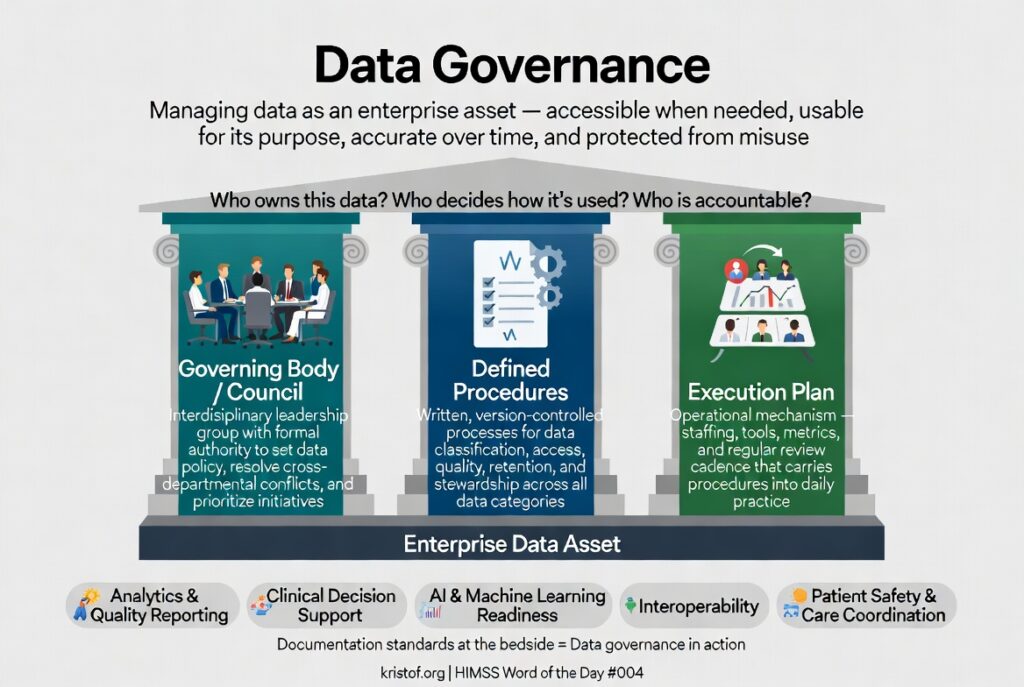
Data governance is the discipline of managing data as an enterprise asset — ensuring it is accessible when needed, usable for its purpose, accurate over time, and protected from misuse. It is the formal answer to the question every healthcare organization eventually faces: who owns this data, who decides how it’s used, and who is accountable when something goes wrong?
A real data governance program — as opposed to a binder full of policies — has three working parts:
| Component | Function |
|---|---|
| Governing Body / Council | An interdisciplinary leadership group with formal authority to set data policy, resolve cross-departmental conflicts, and prioritize initiatives |
| Defined Procedures | Written, version-controlled processes for data classification, access, quality, retention, and stewardship — covering every category of data the organization holds |
| Execution Plan | The operational mechanism — staffing, tools, metrics, and review cadence — that actually carries the procedures into daily practice |
⚠️ Exam Alert: Don’t confuse data governance (the management framework) with data integrity (the accuracy and validity of the data itself), data stewardship (the operational role accountable for data on a day-to-day basis), or data quality (the measurable attributes of fit-for-purpose data). Governance is the program; integrity is a property; stewardship is a job; quality is a measurement. CAHIMS questions present these as competing answer choices for one definition.
🌐 Why It Matters: Real-World Healthcare IT Context
Healthcare runs on decisions made from data, and ungoverned data quietly poisons those decisions.
Duplicate patient records, inconsistent problem-list terminology, and free-text fields where structured data should live — each one degrades quality reporting, analytics, billing accuracy, and increasingly the AI and machine-learning models trained on that data. The “garbage in, garbage out” principle is brutal in clinical informatics: a clinical decision support rule built on poor-quality data is worse than no rule at all, because clinicians trust it.
Data governance is the discipline that decides who owns each data element, what “correct” means for it, and who is allowed to change it. It is unglamorous, often invisible, and absolutely foundational. Every analytics, interoperability, and AI initiative inherits the quality of the governance underneath it.
Failure modes of weak or absent data governance:
- Duplicate patient records that fragment a longitudinal view of care
- Inconsistent terminology across units (e.g., “PCN” vs. “Penicillin” in allergy lists)
- Master data conflicts when systems disagree on the canonical version of truth
- Unreliable quality measure reporting and revenue cycle errors
- AI models trained on biased or incomplete data, producing biased recommendations
- Privacy and security breaches enabled by undefined access policies
Strengths of mature data governance:
- Clear data ownership and stewardship across clinical, financial, and operational domains
- Standardized terminology and code sets aligned to national standards (LOINC, SNOMED CT, RxNorm, ICD-10-CM)
- Master Data Management (MDM) and Enterprise Master Patient Index (EMPI) infrastructure
- Auditable data lineage from source system to analytics output
- Active monitoring of data quality metrics with defined remediation pathways
- AI governance and bias monitoring as an extension of the broader data governance program
The discipline that began with billing and quality reporting now sits at the foundation of every emerging healthcare AI use case.
🏥 The Nurse’s Perspective: Clinical, Bedside, & Workflow
Documentation standards are data governance wearing scrubs.
At the Bedside
When a unit is told to chart pain scores in the flowsheet field rather than narrative notes, that isn’t bureaucratic fussiness — it determines whether pain reassessment compliance can be measured at all. When the EHR mandates structured allergy documentation rather than free text, that mandate is a data governance decision flowing down to nursing workflow.
Every structured field, every required pick-list, every mandated assessment scale exists because some governance committee decided that data needs to be analyzable, comparable, and reportable. The bedside nurse is the data producer, and the structured field is the governance enforcement mechanism.
In Clinical Workflow
Nurses are the largest group of data producers in any hospital, which means governance decisions land on nursing workflow first, and hardest. Flowsheet redesigns, mandatory assessment scales, problem list reconciliation requirements, and medication reconciliation standards all originate in data governance and are operationalized at the nursing station.
When governance is good, nursing documentation feels purposeful and the data flows cleanly into quality reporting, care coordination, and clinical decision support. When governance is poor, nurses end up double-documenting in narrative notes and structured fields, with neither producing reliable analytics downstream.
In EHR Implementation (Go-Live Perspective)
During Epic Go-Lives, data governance decisions made months before the cut-over date determine what nurses see at the bedside on Day 1. Master file builds, flowsheet row inventories, problem list groupers, and orderable item dictionaries are all governance artifacts.
End-user support analysts during Go-Live frequently surface data governance problems that the build team didn’t catch: terminology inconsistencies, missing pick-list values, fields that conflict with regulatory documentation requirements, and structured data fields that don’t match the way clinicians actually think. Capturing those issues and routing them to the data governance committee — not just fixing them locally — is what turns Go-Live support into long-term informatics value.
Clinicians belong on data governance councils for exactly that reason. The decisions made there determine what every nurse, physician, and analyst sees, types, and trusts for years afterward.
🎓 CAHIMS / CPHIMS & HIMSS Perspective
CAHIMS Exam Domain Mapping
Data governance appears across multiple CAHIMS exam domains:
| CAHIMS Domain | How Data Governance Appears |
|---|---|
| Healthcare Information & Systems Management | The primary domain; governance frameworks, data stewardship roles, MDM and EMPI, data quality monitoring, and information lifecycle management |
| Healthcare & Technology Environments | HIPAA and state regulatory requirements driving data governance; standard terminologies (LOINC, SNOMED CT, RxNorm, ICD-10-CM) |
| Clinical Informatics | Data quality dependencies for clinical decision support; structured vs. unstructured documentation tradeoffs; analytics-grade data |
| Management & Leadership | Governance committee structure; change management for documentation standards; aligning data governance with organizational strategy |
Key Terms to Know Alongside Data Governance
- Data Stewardship — the operational, often day-to-day role of accountability for a specific dataset; distinct from the strategic role of governance
- Data Integrity — the property of data being accurate, complete, and valid against defined criteria
- Data Quality — measurable attributes of fit-for-purpose data (completeness, accuracy, timeliness, consistency, and uniqueness)
- Master Data Management (MDM) — the technical and process infrastructure for maintaining authoritative versions of core data elements (patient, provider, location, payer)
- Enterprise Master Patient Index (EMPI) — the specific MDM application focused on patient identity resolution across systems
- Data Lineage — the documented trail of where data originates, how it transforms, and where it is consumed across enterprise systems
HIMSS Organizational Position
HIMSS supports data governance maturity through its Health Information Management programming, the HIMSS Maturity Models, and its Data and Analytics community. HIMSS members can access governance frameworks, case studies, and toolkits through the member portal, and the HIMSS Davies Award recognizes organizations for data governance and analytics excellence.
🔗 Explore Further: External References
- AHIMA — Information Governance https://www.ahima.org/topics/information-governance/
- HealthIT.gov — Health Data, Technology, and Interoperability https://www.healthit.gov/topic/health-it-and-health-information-exchange-basics
- HIMSS — Data and Analytics Resource Hub https://www.himss.org/resources/data-and-analytics
- DAMA International — Data Management Body of Knowledge (DAMA-DMBOK) https://www.dama.org
- NIST — Data Governance Frameworks https://www.nist.gov
- ONC — Standards and Technology https://www.healthit.gov/isa/
Term source: HIMSS Dictionary of Health Information and Technology Terms, Acronyms, and Organizations, 6th Edition (2025). All definitions in this series are paraphrased for editorial purposes. Readers are encouraged to consult the primary source for exact language.
Eric Andrew Kristof, RN, CAHIMS is a Healthcare IT professional and HIMSS Arkansas Chapter member based in Hot Springs Village, AR, with hands-on Epic Go-Live experience and a diverse healthcare and IT background. He writes at kristof.org at the intersection of clinical care and healthcare technology.
Leave a Reply