Published: MAY 28, 2026 Author: Eric Kristof, RN, CAHIMS
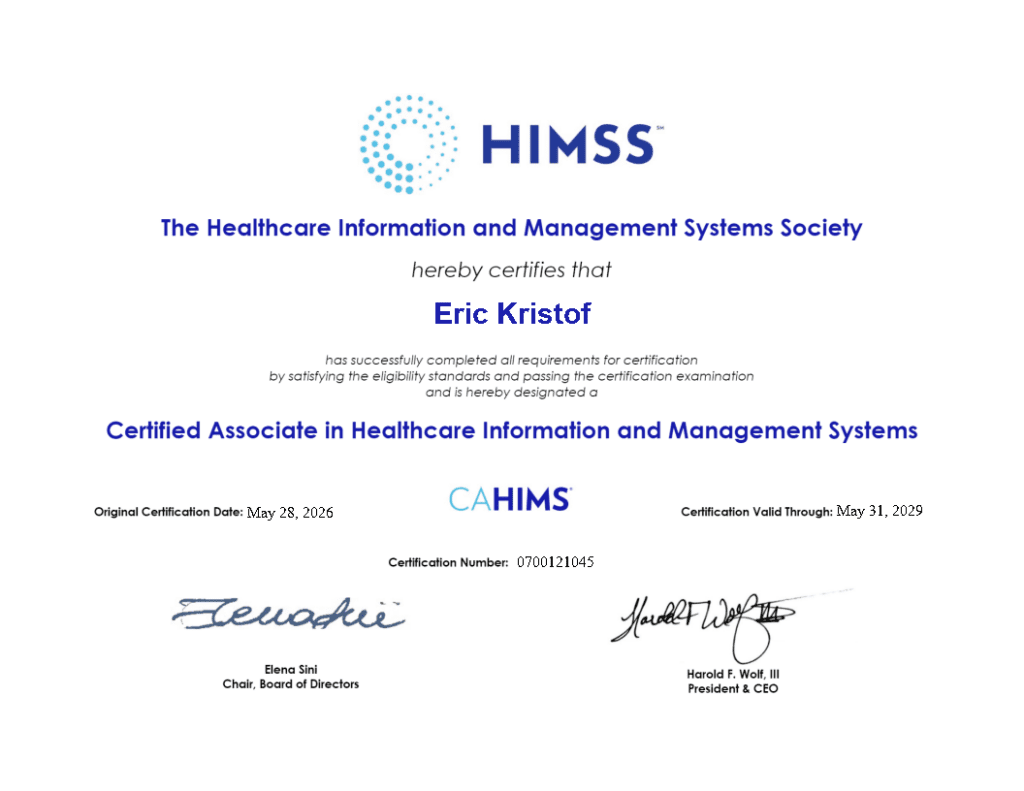
On May 28, 2026, I sat down at the Pearson VUE testing center at National Park Community College in Hot Springs, Arkansas, and walked out with a score of 682 out of 800 on the CAHIMS examination — well clear of the 600 required to pass.
I am now Eric Kristof, RN, CAHIMS.
It feels good to write that.
What Is CAHIMS, and Why Should Anyone Care?
CAHIMS stands for Certified Associate in Healthcare Information and Management Systems. It is the entry-level certification offered by HIMSS — the Healthcare Information and Management Systems Society — the largest global professional organization dedicated to reforming the health ecosystem through information and technology.
Earning the CAHIMS credential demonstrates verified competency across four core content domains:
- Healthcare and Technology Environments — understanding how healthcare organizations are structured, regulated, and funded, and how clinical and administrative technology fits within them
- Clinical Informatics — applying data, clinical vocabulary, and decision-support tools to improve patient care and workflow efficiency
- Healthcare Information and Systems Management — navigating the full system development life cycle, from requirements gathering and vendor selection through implementation, go-live, and post-live support
- Management and Leadership — project management fundamentals, change management, strategic planning, and workforce development in health IT settings
The exam is 100 scored multiple-choice questions delivered over two hours. The passing score is set using the Angoff method — a rigorous psychometric process where expert judges calibrate the difficulty of every question — so a 600 on a 200–800 scale represents genuine demonstrated competency, not an arbitrary cutoff.
Why I Pursued This Credential
My career sits at the intersection of two worlds that don’t always communicate as well as they should: direct patient care and health information technology.
I have worked as a Registered Nurse and have supported Epic EHR implementations and go-live activations at CHI St. Vincent and Mercy in Arkansas. I have stood at the nursing station during go-live week, watched colleagues struggle with new documentation workflows at 2 a.m., and translated between what the system does and what nurses actually need it to do. That dual perspective — clinical and technical — is something I consider a meaningful differentiator in health IT work.
The CAHIMS certification gave me a structured framework to validate, deepen, and communicate that expertise. It also gave me a common professional language with the broader HIMSS community, including my colleagues in the Arkansas HIMSS chapter.
How I Prepared
Preparation took several weeks of focused, daily study. My primary references were the CAHIMS Review Guide, 2nd Edition (2022) and the HIMSS Dictionary of Health Information and Technology Terms, 6th Edition (2025). I supplemented those with practice questions, domain-by-domain self-assessment, and a disciplined approach to tracking weak areas and revisiting them.
My nursing background and my long tenure in Information Technology gave me a natural head start in Clinical Informatics and Healthcare and Technology Environments — I have lived the clinical workflows that those domains describe. The areas that required the most deliberate effort were the regulatory and policy nuances (HIPAA vs. HITECH provisions, NIST Cybersecurity Framework sequence, contingency plan components) and some of the more abstract Management and Leadership frameworks.
That gap showed up honestly in my diagnostic profile: my strongest relative performance was in Healthcare and Technology Environments and Clinical Informatics. Management and Leadership was my lowest domain — a fair reflection of where I should continue to grow, and a roadmap for what I am studying next.
The Score in Context
A scaled score of 682 out of 800 placed me comfortably above the 600 cut score. I am genuinely proud of that result — not because I think a number defines competence, but because it reflects real preparation and real knowledge. I did not get lucky. I studied.
What Comes Next
Passing CAHIMS is a milestone, not a finish line.
My next certification goal is the Claude Certified Architect – Foundations (CCA-F) — Anthropic’s official exam-based credential for professionals who design and build production AI systems with Claude. The exam is scenario-driven and covers five domains: Agentic Architecture & Orchestration (27%), Claude Code Configuration & Workflows (20%), Prompt Engineering & Structured Output (20%), Tool Design & MCP Integration (18%), and Context Management & Reliability (15%).
The healthcare connection is direct. As health systems move from AI pilots to production deployments — clinical documentation assistance, decision support agents, and care coordination workflows — someone needs to design those systems responsibly, with a clear-eyed understanding of both what the technology can do and where it can fail. That person should understand clinical context. That is the role I am building toward, and the CCA-F is the credential that maps most directly to it.
Beyond that, I remain focused on building toward roles that fully leverage both my clinical background and my technical expertise — positions at the intersection of healthcare AI, clinical informatics, and health information systems management.
The healthcare system is generating more data than ever before. The professionals who can bridge the gap between that data and meaningful patient outcomes are increasingly valuable. That is the space I am working to occupy.
Thank You
To the Arkansas HIMSS chapter community: the connections, conversations, and continuing education opportunities you provide have been invaluable. Thank you.
To anyone currently preparing for the CAHIMS exam: it is absolutely achievable. Study the Review Guide carefully, take the diagnostic domains seriously, and do not underestimate the Management and Leadership section. If your background is clinical — lean into it. That perspective is an asset, not a detour.
Eric Kristof is a Registered Nurse and Certified Associate in Healthcare Information and Management Systems (RN, CAHIMS) based in Arkansas. He has supported Epic EHR implementations and go-live activations at CHI St. Vincent and Mercy, and is an active member of the Arkansas HIMSS chapter. He is currently pursuing the Claude Certified Architect – Foundations (CCA-F) certification from Anthropic.
Tags: CAHIMS, HIMSS, Healthcare IT, Health Informatics, Nursing, Epic EHR, Certification, Arkansas HIMSS, CCA-F, Claude Certified Architect, Healthcare AI, Agentic AI
Leave a Reply